
Lod, Ginnaton Junction (A-8767)
Permit/License Number
A-8767
Excavation Report
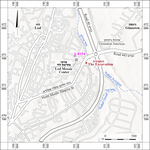
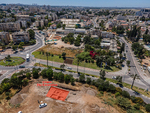
During June 2020, a salvage excavation was conducted in Lod, southwest of Ginnaton Junction (Permit No. A-8767; map ref. 191155–70/651405–25; Figs. 1, 2), prior to the establishment of the Nofei Ben Shemen neighborhood. The excavation, on behalf of the Israel Antiquities Authority and funded by the Lod Economic Company, was directed by A. Zilberstein with the assistance of Y. Amrani and Z. Lotan (administration), Y. Mermelstein (probes), M. Kahan and I. Jonish (surveying and drafting), A. Wiegmann (field photography and photogrammetry), S. Krispin (supervision, metal detector and identification of metal artifacts), Y. Tepper (scientific guidance), I. Delerson (plan), P. Gendelman and I. Taxel (pottery identification), M. Shuiskaya (pottery drawing), T. Winter (glass), C. Hersch (glass drawing), H. Sokolov and L. Sandberg (numismatics), S. Goralik and I. Reznitzky (metal laboratory) and D. Gazit (studio photography). Assistance was also rendered by D. Ben-Ami (district archaeologist), A. ‘Azab (regional archaeologist) and I. Kornfeld (subdistrict archaeologist).
The excavation was located west of Naḥal Ayyalon and Road 40 and south of Tel Lod, which was occupied from the Pottery Neolithic until modern times (Kaplan 1977; Yanai and Marder 2000; Golani 2012, and see there for further references). A villa dated to the Late Roman period and an impressive complex of colorful mosaics was discovered c. 150 m northwest of the excavation (‘the Lod mosaic’), and architectural remains from the villa indicate continuous occupation from the Early Roman period (first–second centuries BCE) to the Abbasid period (second half eighth–early ninth centuries CE). A few remains dated to the late Ottoman period and the British Mandate were also found (Avissar 1996; Avissar 1999; Gorzalczany 2015; Gorzalczany et al. 2016). Northeast of the Late Roman-period villa, excavations uncovered a peristyle courtyard that was probably part of another villa dated to the Byzantine period (Zilberstein 2019 [Fig. 1: A-8154]).
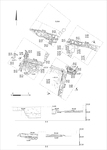
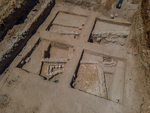
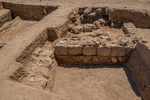
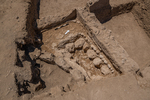
Four excavation squares were opened (Figs. 3, 4), revealing the remains of a single-period complex winepress from the seventh–early eighth centuries CE and a twentieth century CE cesspit that cut the winepress’ treading floor. The finds included ceramic, glass and stone vessels, a bone artifact, metal objects and 25 bronze coins, five of which were identified. Prior to the excavation, accumulations of soil and refuse (depth c. 2.5 m) were cleared with mechanical equipment.
Complex Winepress
Remains of a complex winepress, which probably originally had two levels, were discovered. Only remains from the lower level survived, including a treading floor (L129) and two fermentation cells to its north (L139, L140). West of the winepress was a mosaic floor of another installation (L137) that was mostly unpreserved. In the northern part of the area, the two levels of the winepress were separated by a wide and long wall (W105, W111) constructed of large fieldstones interspersed with pebbles. South of the wall, an organized pebble layer (L122, L123) was uncovered; this may be the bedding of an activity surface that was not preserved in the center of the winepress.
Based on comparisons to similar winepresses from sites in the vicinity (Masarwa 2022; Avrutis 2015:7–81), it can be suggested that on the lower floor, roofed cells were built around the treading floor, and level with these roofed cells, an upper level was built.
Treading Floor 129. Only the northern part of the treading floor was exposed. It was bounded by ashlar walls (W120, W130, W131; width c. 0.4 m), constructed using the stretchers technique (Fig. 5) and coated with light-colored plaster on the inner face. The floor (L118, L129) was made of an industrial mosaic, of which only a few rows survived near the juncture with the wall. The bedding of the mosaic floor was comprised of six layers of varying thicknesses, designed to ensure the installation’s stability (Fig. 6). The excavation exposed the upper four layers, which will be described from the highest to the lowest: (a) a white, thick and hard plaster layer (thickness 0.1 m); (b) a layer of medium-sized pebbles (thickness 0.1–0.2 m); (c) another plaster layer; (d) a layer of large and medium-sized fieldstones (thickness 0.30–0.35 m) bound with a hard mortar. The excavation did not extend below these four bedding layers, but there was evidence for at least two additional layers composed of small and medium-sized fieldstones (thickness c. 0.2 m) bound with a hard mortar. The structure of the bedding attests to the high quality of construction and the engineering knowledge and resources invested in constructing the winepress.
Cells 139, 140. The cells were bounded by partition walls cast from a hard gray mortar mixed with small fieldstones. Cell 139 was almost completely preserved, and it was paved with an industrial mosaic that was laid somewhat carelessly. On the outer face of the cell walls, remains of an additional casting (L143) were exposed, perhaps a repair or a base of an external channel.
Installation Floor 137. Meager remains of another mosaic floor were uncovered west of the treading floor. This suggests that there was another installation or cell.
Winepress Establishment. South of W105, the excavation was deepened below the elevation of the winepress’ foundation to determine the date of its construction and rule out the existence of earlier construction phases. A fill of dark brown-gray soil (L134) was uncovered below Pebble Layer 122, and below this layer, there was a scatter of large fieldstones and a layer of similar colored soil (L144). A continuation of Soil Layers 134 and 144 was uncovered further east (L109, L147 respectively). Beneath Soil Layer 144, a layer of sterile clayey soil was found, indicating that there was no earlier construction. The placement of the soil layers between the pebble layer and the virgin soil indicates that they served as bedding for the winepress. Numerous finds were discovered in these layers, including fragments of pottery and glass vessels, two coins and metal and bone artifacts that date the winepress to the Umayyad period (seventh–early eighth centuries CE) at earliest.
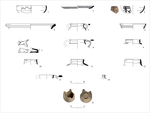
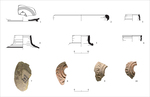
Two groups of vessels were identified in the pottery assemblage from the fill layers of the winepress bedding (L134, L142, L144, L147). One includes types that were used from the late Byzantine period into the Umayyad period (sixth–seventh centuries CE, and sometimes until the eighth century CE; Fig. 7), while the second group includes vessel types that were used in the Umayyad and Abbasid periods (seventh–eighth centuries CE; Fig. 8). The pottery assemblage consists of mainly local vessels, with a few imported bowls. The local vessels from the earlier group include an FBW bowl (Fig. 7:1), a basin (Fig. 7:4), a cooking pot (Fig. 7:5), casseroles (Fig. 7:6, 7), jars (Fig. 7:8–12), a jug (Fig. 7:13), a juglet (Fig. 7:14) and an oil lamp (Fig. 7:15). A few imported bowls were also attributed to the early group: a north-African bowl with a shouldered-rim (Fig. 7:2) and a Coptic bowl decorated in black and red (Fig. 7:3), which was identified as an import based on, among other things, the composition of its yellowish fabric and the inclusions in it. The later group includes bowls (Fig. 8:1–3), among them two FBW imported bowls (Fig. 8:2, 3), jars (Fig. 8:4–7) and a flask (Fig. 8:8).
The glass assemblage (from L109, L134, L144 and L147) is dated predominantly to the end of the Byzantine and the Umayyad periods (sixth–seventh centuries), although some is dated later to the Umayyad or the early Abbasid period (seventh–eighth centuries CE; below, T. Winter).
The two coins (from L109) were dated to the Byzantine period (end of sixth century CE). One (IAA 173787) was minted in Nicomedia in 570/1 CE during the reign of Justinian II. The other dates to Mauricius Tiberius (582–602 CE; IAA 173786).
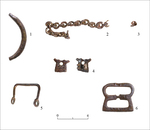
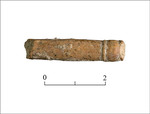
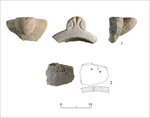
The metal and bone artifacts include a bronze link chain (Fig. 9:2) and a fragment of a cylindrical bone object (L109, Basket 1159; Fig. 10).
Winepress Abandonment. The poor preservation of the winepress suggests that tesserae from the treading floor and stones from the treading floor walls and the fermentation cells were stolen. Directly above the remnants of the winepress, excavations exposed sealed sedimentary accumulations, containing pottery finds that date the end of the winepress use to the late Umayyad or early Abbasid period (eighth century CE). A glass vessel fragment and metal finds were also recovered. Above these soil accumulations were additional accumulations (L114) that were sealed by modern refuse layers; fragments of ceramic, glass and stone vessels, two coins and metal objects were found in these accumulations.
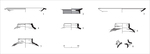
The pottery assemblage from the soil accumulations that sealed the treading floor and Cell 139 includes fragments of a krater (Fig. 11:2), jars (Fig. 11:3–6) and an oil lamp (Fig. 11:7) dated mostly to the Umayyad–early Abbasid periods (seventh–eighth centuries CE). Jars Nos. 4 and 5 are zir jars, with Jar No. 5 typical exclusively of the Abbasid period (eighth–ninth centuries CE). Jar No. 6, found in the soil accumulations above Treading Floor 129, is a typical jar of the Ottoman period. The glass vessel fragment that was found in these accumulations is from a type of bottle that dates to the seventh–eighth centuries CE (below, T. Winter; Fig. 14:12). The metal finds in the same accumulations include bronze artifacts, such as a tiny bent nail (Fig. 9:3), a clasp (Fig. 9:4), belt buckles (Fig. 9:5, 6) and chunk of lead alloy (Fig. 9:7).
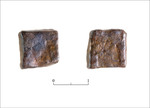
In the upper soil accumulations (L100, L121) that sealed the winepress and were covered by modern refuse, pottery sherds were discovered, including an imported bowl (Fig. 11:1) and three oil lamps with inscriptions (Fig. 11:8–10). From these accumulations, the glass assemblage includes a wineglass from the sixth–seventh centuries CE and bottles from the seventh–eighth centuries CE (below, T. Winter). In the soil accumulations (L114), stone vessels were also found, including a shallow marble grinding bowl (Basket 1090; Fig. 13:1) typical of the Late Roman and Byzantine periods and a fragment of a stone vessel (gneiss schist; Basket 1199; Fig. 13:2) typical of the Early Islamic period (Chachy-Laureys 2010:304–305, Pls. 14.3–14.4; Torgë 2019). The two coins that were found in the upper accumulations were minted in the Umayyad period and postdate the monetary reform of 697 CE. One is a square coin of the ‘Byzantine-Arabic I’ type, minted in the beginning of the Umayyad period in 645–670 CE (L103; IAA 173790; Fig. 12). The other coin was minted in Ramla between 711–750 CE (L128; IAA 173789). The metal objects that were found in the upper soil accumulations (L100) include a handle of a small bronze vessel (Fig. 9:1) and two iron nails (not photographed).
Modern Cesspit
A cesspit (L113) dug into the ground and lined with stones (W151) was uncovered in the southwestern boundary of the area. It cuts Treading Floor 129 and was apparently dug into a screw-press instillation located in the winepress. Plastic and other modern finds were discovered between the lining stones, indicating that the cesspit was installed in recent decades. The cesspit was also covered by the modern accumulations of soil and refuse that were cleared prior to the excavation.
The Glass Finds
Tamar Winter
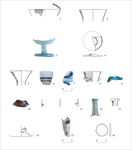
The glass finds from the excavation include 51 diagnostic fragments of vessels mostly typical of the late Byzantine–Umayyad periods, including bowls, wineglasses, bottles and lamps; a glass disc that was used as an inlay was also found. Most vessels are made of greenish-blue glass, while a few are made of brown and turquoise-blue glass, typical of these periods. Some of the bowls, wineglasses and bottles are decorated with a thin blue or turquoise-blue trail wound several times on and below the rim (see below Fig. 14:1), the most widespread decoration scheme in the Late Roman and Byzantine periods. Other decoration techniques, mostly applied on bottles, are typical of the late Byzantine and Umayyad periods, and include a pinched trail (see below Fig. 14:7) or a thick wavy trail (see below Fig. 14:8, 9) as well as rows of pinches on the vessel wall (see below Fig. 14:10).
Bowls. Most of the bowls are characterized by a rounded rim, while a few have an out-folded rim (not illustrated). One rounded rim (Fig. 14:1) adorned with a blue trail densely wound on the rim and below it belonged to a bowl or a wineglass. Similarly decorated rims were previously unearthed in assemblages dated primarily to the fourth–fifth centuries CE (Winter 2019:27, Type BLtd).
Wineglasses. Wineglasses are identified by their rims or bases. One fragment (Fig. 14:2) is adorned with a trail wound on and below the rim. Wineglasses with this decoration were widespread in Syria-Palestine, primarily in the sixth–seventh centuries CE. Two types of wineglass bases were also found: a hollow ring base (Fig. 14:3, and additional bases from L109, L118, L129, L134, L145, L147) and a solid base (Fig. 14:4, and another base from L147). Wineglasses with a ring base first appeared in the early Byzantine period and remained in use in the Umayyad period. Wineglasses with a solid base were only introduced in the late Byzantine period and remained in use until the eighth century CE (Winter 2019:32–36, Types WGhb, WGsb).
Bottles and decorations most of which adorned bottles. Most of the bottles and decorations (most of which adorned bottles) discovered in the excavation are typical mainly of the Byzantine and early Umayyad periods, and only a few are characteristic of the Umayyad and early Abbasid periods. One of the bottles has an infolded rim (Fig. 14:5) and is typical of the late Byzantine and Umayyad periods (Winter 2019:41–42, Type BTir).
Nevertheless, most of the bottles from these periods have a rounded rim, and some are adorned with a thin trail, of a color darker than that of the bottle, wound on and below the rim. Examples adorned with a blue trail were the most widespread in Syria-Palestine (e.g. from L109, L145, L147; not illustrated), while the brown color of the trail adorning another bottle (Fig. 14:6) is characteristic of the Umayyad period (Winter 2019:43–46, Type BTtd).
Additional bottles are adorned with a pinched trail (bifurcated; Fig. 14:7) or a thick wavy trail (Fig. 14:8, 9). These two decoration techniques are characteristic mostly of the seventh–eighth centuries CE (Winter 2019:46–47, Types BTwt, BTpt). Bottle No. 8 is also decorated with mold-blown diagonal ribbing. Additional pieces dated to these centuries include a brown body fragment adorned with a row of pinches (Fig. 14:10; Winter 2019:68–69, Type DDrp) and a wall fragment with an internal fold (Fig. 14:11). Other bottles have an infolded and flattened rim (Fig. 14:12, 13, and a fragment from L109), and are typical of the Umayyad–early Abbasid periods (Winter 2019:47–48, Type BTTifr).
Lamps. Bowl-shaped and stemmed lamps were discovered. The bowl-shaped lamps include a bottom installed with a wick tube (Fig. 14:14) and a fragment bearing part of a handle (not illustrated). The stemmed lamp (Fig. 14:15) has a hollow cylindrical stem; preserved at its lower end are remnants of a glass wad that was attached to the lamp during the manufacturing process. Lamps of both types were widespread in the Byzantine–Umayyad periods (Winter 2019:51–57, Types LBB, LST).
Inlay. A colorless glass disc (diam. 13 mm, thickness c. 1 mm, Fig. 14:16) was carelessly cut to form a circular shape. Small (diam. 10–30 mm), thin, circular discs with wavy or serrated edges were probably used as inlays, occasionally in jewelry. Such discs were previously found in assemblages dated mostly to the fourth–seventh centuries CE (Winter 2019:84–85, Type ARTSD).
Conclusion
A complex winepress from the seventh–eighth centuries CE was exposed in the excavation, likely associated with the wine industry in the rural hinterland of Lod during the Umayyad period. Wine production took place outside settlements, near the vineyards, so the location of the winepress may indicate that it was outside the city limits. The finds indicate that the winepress was constructed during the Umayyad period at earliest (seventh century CE), and it went out of use during the late Umayyad or early Abbasid period (eighth century CE). This winepress provides evidence for continued consumption of wine in Lod even at the beginning of the Early Islamic period. This evidence aligns with a broader phenomenon observed along the coast and in other areas, in which the wine industry began to decline during the mid-sixth and early seventh century CE. The industry continued to decline during the beginning of the Early Islamic period, and wine production ceased completely in the eighth century CE. This indicates that the change in wine consumption during the sixth–eighth centuries CE was a gradual process. The decline was linked to environmental and political changes and the Muslim prohibition on wine drinking that emerged during this period (Ayalon 1997:163–166; Avrutis 2015:204–208).
Additional examples of winepresses that were active near Lod and Ramla until the eighth century CE are known from the excavation of the Nesher Ramla quarry (Avrutis 2015:7–54) and perhaps from an excavation south of Ramla (Gorzalczany and Marcus 2010). As Tepper demonstrated (Tepper 2011; Tepper 2018; Tepper 2019) through the identification of winepresses in Tamra, in exceptional cases, wine production continued mostly in regions where Christian populations were concentrated throughout the Early Islamic period and past the eighth century CE.
Dating the construction of the excavated winepress to the seventh century CE and noting its continued use following the foundation of Ramla as the provincial capital may contribute to the study of the identity and customs of the population of Lod during the beginning of the Early Islamic period.
References
Avissar M. 1998. Lod – A Mosaic Floor. ESI 17:169–172.
Avissar M. 1999. Lod—Mosaic Pavement. Qadmoniot 32:41–43 (Hebrew).
Avrutis V.W. 2015. Wine Presses at Nesher-Ramla Quarry: A Thousand Years of Winemaking. Haifa.
Ayalon E. 1997. The End of the Ancient Wine Industry on the Central Coastal Plain. In Z. Safrai, Y. Freidman and J. Schwartz, eds. Hikrei Eretz: Studies in the History of the Land of Israel. Ramat Gan. Pp. 149–166 (Hebrew).
Chachy-Laureys R. 2010. The Stone Artifacts. In O. Gutfeld. Ramla: Final Report on the Excavations North of the White Mosque (Qedem 51). Jerusalem. Pp. 303–323.
Golani A. 2012. Lod. HA–ESI 124. https://doi.org/10.69704/jhaesi.116.2004.1938
Gorzalczany A. 2015. The Roman Manor at Lod. In The Lod Mosaic: A Spectacular Roman Mosaic Floor. London–New York–Jerusalem. Pp. 38–49.
Gorzalczany A. and Marcus J. 2010. Ramla (South). HA–ESI 122. https://doi.org/10.69704/jhaesi.116.2004.1335
Gorzalczany A., Avissar M., Torgë H., ‘Ad U., Jakoel E. and Elisha Y. 2016. Lod, the Lod Mosaic. HA–ESI 128. https://doi.org/10.69704/jhaesi.116.2004.24984
Kaplan J. 1977. Neolithic and Chalcolithic Remains at Lod. Eretz-Israel 13:57–75 (Hebrew; English summary, pp. 291*–292*).
Masarwa D. 2022. Kefar Sirqin (South). HA–ESI 134. https://doi.org/10.69704/jhaesi.116.2004.26160
Tepper Y. 2011. Tamra. HA–ESI 123. https://doi.org/10.69704/jhaesi.116.2004.1808
Tepper Y. 2018. A Church from the Byzantine, Umayyad and Abbasid Periods and Remains from Iron Age I at Ṭamra (ez-Zuʻabiyya) in Ramat Issakhar. ‘Atiqot 90:56*–106* (Hebrew; English summary, pp. 168–171). https://doi.org/10.70967/2948-040X.1834
Tepper Y. 2019. Ṭamra, in the Valley. HA–ESI 131. https://doi.org/10.69704/jhaesi.116.2004.25630
Torgë H. 2019. Pottery and Stone Finds. In R. Toueg. Ramla, Trumpeldor Street. HA–ESI 131. https://doi.org/10.69704/jhaesi.116.2004.25560
Winter T. 2019. Lucid Transformations: The Byzantine–Islamic Transition as Reflected in Glass Assemblages from Jerusalem and Its Environs, 450–800 CE (BAR Int. S. 2946). Oxford.
Yannai E. and Marder O. 2000. Lod. HA–ESI 112:63*–65*.
Zilberstein A. 2019. Lod, Ha-H̱alutz Street. HA–ESI 131. https://doi.org/10.69704/jhaesi.116.2004.25670
Keywords
Umayyad Period, Early Abbasid Period, Complex Winepress, Wine Industry, Industrial Mosaic Pavement, Glass Vessels, Umayyad Coins
Publication Date
06/09/2026
Link to Excavation Repository
Report Type
Final Report