
El-Rom (South) (A-8775)
Permit/License Number
A-8775
Excavation Report
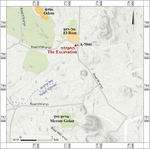
During June 2020, a salvage excavation was conducted at El-Rom Junction, south of Kibbutz El-Rom (Permit No. A-8775; map ref. 272483–679/786682–814; Fig. 1), following damage caused by agricultural planting. The excavation, on behalf of the Israel Antiquities Authority and funded by Moshav Alonei Ha-Bashan, was directed by T. Lang (field photography) and E. Bron, with the assistance of Y. Ya‘aqobi (administration), R. Mishayev (surveying and drafting), E. Dalali-Amos (plans), A. Elghani Ibrahim (photogrammetry), A. Shapiro (drafting and maps), J. Gosker (scientific consultation), Y. Gorin-Rosen (Glass finds), H. Tahan-Rosen (pottery and glass drawing), workmen from Buq‘ata and Kabul and additional workers from the community.
Architectural remains from the Mamluk and Ottoman periods were found in a salvage excavation conducted in 2007 about 15 m northeast of the current excavation, as well as a cluster of pottery from the Middle Bronze Age (Bron 2009 [Fig. 1: A-5046]). A survey conducted southwest of the excavation identified walls, pens, fences, dolmens and remains of buildings, some of them recent (Zingboym 2008). In the Merom Golan Map Survey, three sites were documented in the vicinity (Hartal 2017: Sites 29–31).
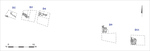
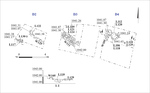
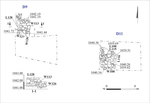
Ten excavation squares were opened (D2–D11; 250 sq m) in the present excavation, but due to time and budget constraints, the excavation concentrated only on five (Fig. 2): three in the western part of the area (D2–D4; Fig. 3; 3D model) and two in the eastern part (D9 and D11; Fig. 4; 3D model). Pottery sherds from the Middle Bronze Age II (Stratum III) and architectural remains from the Mamluk (Stratum II) and Ottoman (Stratum I) periods were found.
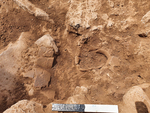
Stratum III—The Middle Bronze Age II. The top of a large Middle Bronze Age IIA storage jar was found in a natural niche in the bedrock in Square D11 (L116; Fig. 5). A layer of fairly hard brown soil (L124), containing pottery fragments (not illustrated), was found in Square D3; they seem early and may date to the Middle Bronze Age.
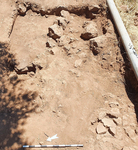
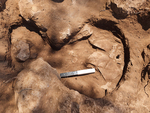
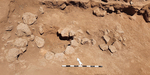
Stratum II—The Mamluk Period. In Square D2 (Fig. 6), an occupation level (L130), containing a circular installation (L117) and a hearth (L122), was found. A broken grinding stone (Fig. 7) was found at the bottom of the installation. The hearth was comprised of two adjacent circles dug into the ground, with a narrow passage connecting them (Fig. 8). Inside the hearth, there was burnt ash, suggesting that this was a cooking area. In the center of the area, a wall, built from a single row of fieldstones (W125), was found; the wall was exposed to a height of one course and was seemingly used as a partition wall.
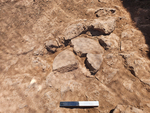
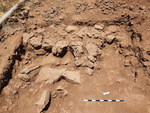
A wall (W111), built of two rows of fieldstones filled with a core of small stones and soil, was found in Square D3 (Fig. 9). The wall survived to a height of 1–2 courses. A packed-earth floor (L121) abutted the wall from the north. Large quantities of white-gray charcoal and ash were found on the floor, indicating that this was also a cooking area.
A wall (W105) and a hearth (L118) were uncovered in Square D4 (Fig. 10). A row of fieldstones was preserved from W105. Next to the wall on the west, a few small stones, probably from its core, were found; the wall’s western face is outside the excavation boundary. From the east, the wall was abutted by a layer of tamped soil (L129) and, above it, a layer of reddish-brown soil (L106 and L110), probably composed of deteriorated bricks. Ottoman-period pottery was found in the reddish-brown layer. Hearth 118 was dug into these layers; its sides were built of fieldstones, and its interior was lined with plaster. The lower part of the hearth was filled with dark brown soil mixed with a large quantity of charcoal (L120), and its upper part was filled with a white ash layer (L112).
Remains of a building, including two walls (W126, W127) and a floor (L128), were uncovered in Square D9 (Fig. 11). Wall 126, whose upper part was exposed, was built of one row of large fieldstones; its eastern part was cut by a later wall (W113; see below, Stratum I—the Ottoman period). Wall 127 abutted Wall 126 from the west, and it was built of a single row of large fieldstones. Stone Floor 128 abutted W127 from the north; the floor continued north, below the foundations of the late W113. This floor did not abut Wall 126 to its east, perhaps because it was damaged by the construction of Wall 113. The extent of the excavation in this square makes it difficult to understand the nature of the building.
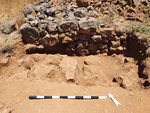
In Square D11, W108 was exposed (Fig. 12). It was formed of a row of large fieldstones preserved to a height of 1–2 courses and a core of small and medium-sized stones to its west. The wall’s western face was probably beyond the excavation’s boundaries. A cluster of stones (L115) was exposed north of the wall; it may be another poorly preserved wall. A metal arrowhead (see below) was found among these stones.
Stratum I—The Ottoman Period. An accumulation of soil (L109) containing numerous Ottoman-period pottery fragments was uncovered in Square D3 above Floor 121. No architectural remains or installations were identified.
The southern face of a wall (W113) that was part of a building from this period, which is still standing, was uncovered in Square D9 (see Fig. 11). The wall was preserved to a height of 3–4 courses.
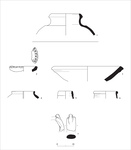
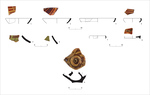
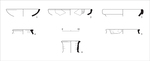
Pottery. The top of a large storage jar (Fig. 13:1) was found and dated to the Middle Bronze Age IIA. From the Mamluk period, handmade pottery, including a bowl (Fig. 13:2), a basin (Fig. 13:3), jars (Fig. 13:4–6) and a pithos handle (Fig. 13:7), was found, as well as a range of glazed bowls (Fig. 14:1–8) and a glazed oil lamp (Fig. 14:9). Pottery from the Ottoman period includes Rashaya el-Fukhar ware, such as bowls (Fig. 15:1, 2), a basin (Fig. 15:3), cooking pots (Fig. 15:4, 5) and a jar (Fig. 15:6).
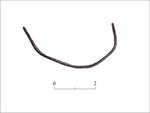
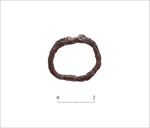
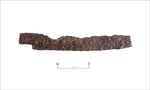
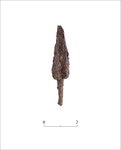
Metal Objects. A fragment of a bronze bracelet (L110, Basket 1057-3; Fig. 16); a bronze ring that likely held a, now lost, inlay (L102, Basket 1010; Fig. 17); and part of an iron sickle blade with a tang for hafting (L110, Basket 1057-2; Fig. 18) were recovered. These objects probably date to the Mamluk period. A Mamluk-period iron arrowhead (L115, Basket 1018; Fig. 19), formed in a type that was used since the Roman period, was also found. Mamluk-period arrowheads of this type were found in Ẓefat (Barbé 2014). An identical arrowhead was found about 15 m north of this excavation (Bron 2009).
The Glass Finds
Yael Gorin-Rosen
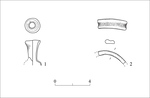
Three glass artifacts were found in this excavation: a fragment of a bottle and two bracelet fragments. The bottle is made of colorless glass with a light purplish hue (L103, B1047; Fig. 20:1), and only its upper part survived. The fragment includes a rounded rim, a funnel neck and the beginning of a shoulder. The rim was rounded by fire, and the workmanship is careless. Based on the shape of the rim and shoulder, this was probably a small cosmetics bottle with a square-sectioned body, a type common during the Early Islamic period that remained in use until the Mamluk period. A similar bottle was found at Tiberias in Stratum I, which was dated to the late Fatimid period (1033–1100 CE; Lester 2004:190, Fig. 7.9:106; Stacey 2004:23), and more were found at Bet She’an and dated to the late Umayyad period through the Fatimid period (Hadad 2005:101, Pls. 35:296, 297; 36:699–702).
One bracelet fragment is dark, severely deteriorated and covered with silvery weathering (L109; not illustrated). It has a D-shaped cross-section, and it belongs to a type that was used from the Late Roman to the Ottoman period. Fifty-one bracelets of this type were found in the excavations at Bab el-Hawa, together with glass vessels that were dated to the Late Roman and Byzantine periods (Hartal 2005:240–242, Fig. 164:1–3). The second bracelet fragment is dark, covered with silver weathering, iridescence and severe pitting (L110, B1058; Fig. 20:2). It is a unique bracelet type, characterized by a horizontal groove around its central circumference, which creates two flanking ridges. A similar bracelet made of dark glass was found in the excavation at Umm ez-Zeinat, on the eastern slopes of Mount Carmel, in a context dated to the Late Roman and Early Byzantine periods (Gorin-Rosen, Talmi and Kirzner 2023:165, Fig. 6:3). The glass finds reflect additional periods beyond those of the settlement phases documented at the site.
Conclusion. Middle Bronze Age II finds from the site include the upper part of a large storage jar and perhaps additional pottery fragments, but no building remains. This suggests that a yet-unexposed settlement dated to this period was in the vicinity. This is similar to the picture painted by the nearby excavation at El-Rom Junction (Bron 2009). Moshe Hartal’s survey of the area did not discover any Middle Bronze Age settlements, and the only site where Middle Bronze Age pottery was found is Bab el-Hawa, about 3.5 km south of El-Rom Junction (Hartal 2017: Site 53). The main finds from the Mamluk period are remains of walls, floors and cooking installations, supporting the existence of a rural settlement. An arrowhead that was found in the eastern part of the excavation, identical to one found at the nearby excavation at El-Rom Junction, raises questions about the nature of the settlement. Another site with Mamluk-period finds is Kom er-Rumman, north of El-Rom (Hartal 2017: Site 19). The site remained active after the Mamluk period, during the Ottoman period. About 2.5 km northwest of the excavation, an ancient east–west road of unknown date was documented; it may have also served the inhabitants of this site (Hartal 2017: Site 15).
References
Barbé H. 2014. Mamluk and Ottoman Remains in the al-Waṭa Quarter, Safed (Ẓefat). ‘Atiqot 78:113–137. https://doi.org/10.70967/2948-040X.1682
Bron H. 2009. El-rom Junction. HA-ESI 121. https://doi.org/10.69704/jhaesi.116.2004.985
Hadad S. 2005. Islamic Glass Vessels from the Hebrew University Excavations at Bet Shean (Qedem Reports 8). Jerusalem.
Hartal M. 2005. Land of the Ituraeans: Archaeology and History of Northern Golan in the Hellenistic, Roman and Byzantine Periods (Golan Studies 2). Qaẓrin (Hebrew; English summary, pp. 1*–7*).
Hartal M. 2017. Map of Merom Golan (11/1) (Archaeological Survey of Israel).
Lester A. 2004. The Glass. In D. Stacey. Excavations at Tiberias, 1973–1974: The Early Islamic Periods (IAA Reports 21). Jerusalem. Pp. 167–220. https://doi.org/10.69704/iaaRepV000.1996.57
Stacey D. 2004. Excavations at Tiberias, 1973–1974: The Early Islamic Periods (IAA Reports 21). Jerusalem. https://doi.org/10.69704/iaaRepV000.1996.57
Zingboym O. 2008. El-Rom (Southwest), Development Survey. HA-ESI 120. https://doi.org/10.69704/jhaesi.116.2004.931
Keywords
Middle Bronze Age 2, Mamluk period, Ottoman period, settlement remains, bronze jewelry, iron sickle blade, iron arrowhead
Publication Date
07/09/2026
Link to Excavation Repository
Report Type
Final Report