
Tel Aviv, Qiryat Shalom (A-9376)
Permit/License Number
A-9376
Excavation Report
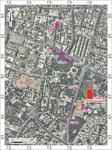
During August–September 2022, a salvage excavation was conducted at Qiryat Shalom in southern Tel Aviv (Permit No. A-9376; map ref. 178773/661577; Fig. 1), prior to infrastructure work. The excavation, on behalf of the Israel Antiquities Authority and funded by the Tel Aviv–Yafo municipality, was directed by A. Reiss (field photography), with the assistance of Y. Tepper (scientific guidance), D. Barkan (Tel Aviv District archaeologist), D. Abu Salah (Tel Aviv Sub-District archaeologist), Y. Amrani and Z. Lotan (administration), L. Rauchberger (preliminary inspection, site preparation and scientific guidance), A. Bouchenino (preliminary inspection and pottery), R. Hoofien (preliminary inspection), I. Jonish (field photography, drafting and photogrammetry), C. Segal (surveying), Y. Gomani (drafting), A. Dagot (GIS), Y. Arbel (consultancy), A. Sasson (consultancy and metal objects), P. Gendelman (pottery), N. Wieler (analytical laboratory and geology), Y. Asscher (analytical laboratory), Y. Gorin-Rosen (glass), D. Gazit (studio photography), M. Shuiskaya (drawing and digital scanning), I. Reznitsky (metal laboratory), R. Kool (numismatics) and M. Intrator (archaeozoology).
The area surrounding the excavation is characterized by clayey and sandy soil as well as alluvial sediments, which allowed the formation of local and regional aquafers that supported agriculture throughout time (N. Wieler, pers. comm.). Yafo and its surrounding area feature numerous citrus orchards, which were established during the late Ottoman period. From then on, a rich agricultural industry of citrus cultivation emerged, producing for local consumption and export. As part of this industry, various structures were built within the citrus orchards, including wells (biarot), reservoirs, water-transport systems that supplied the reservoirs, irrigation canals, farmhouses, drinking fountains (sabil) and other related facilities. As the citrus industry expanded, the architecture and technology of the orchards advanced. Citrus orchards were found in the vicinity of the present excavation, including Biarat La-Cortila and Biarat Amzalag to the west and Biarat Musai to the south (Sasson 2009:65–66). The remains of a few orchards were excavated and documented within the boundaries of Tel Aviv–Yafo (Gorzalczany 2008; Rauchberger 2012; Arbel and Rauchberger 2015; Raucherger 2015; Arbel 2017; Dagot 2019 [Fig. 1: A-8206]; Moshe 2019a [Fig. 1: A-8246]; Moshe 2019b [Fig. 1: A-8277]; Permit No. A-9092). To the west of the excavation area, prior excavations revealed a Jewish cemetery from the Late Roman and Byzantine periods with burial complexes hewn into the kurkar outcrop (Ajami 2006 [Fig. 1: A-3769] and see references there). Prior to the current excavation and associated infrastructure work, a football field, which was home to the Gadna Tel Aviv Yehuda Football Club since 1953, was demolished.
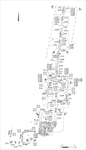
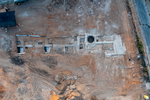
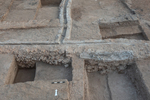
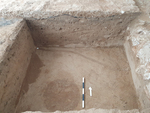
Fourteen squares were opened in the present excavation (Figs. 2–5; 3D model). The remains of a citrus orchard dating to the late Ottoman and British Mandate periods were uncovered, including three rooms (1–3), a Saqiye well (L165), a reservoir (L176) and an irrigation canal system (L108, L109). These remains belong to an orchard complex that was first documented in Sandel’s map from 1878/9 and in British Mandate maps and aerial photographs (Shacham 2011:140, Fig. 13/19). Large quantities of small finds were found in the excavation, including pottery (see below, P. Gendelman) and glass vessels (see below, Y. Goring-Rosen) dated to the late Ottoman period and the British Mandate, metal objects and animal bones (see below M. Intrator). Twelve coins, most of them bronze, were also found; one is a fals that was minted in Cairo during the reign of the Mamluk Sultan al-Ashraf Sha‘ban II (1364–1365 CE; L118, Basket 1157; IAA 189258), three were dated to the Ottoman period, one was dated to the British Mandate and seven could not be dated. During the excavation, soil samples were collected from agricultural plots close to the irrigation canals for geo-archaeological research (to be published separately).
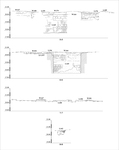
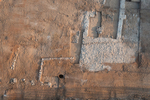
Room 1 (Fig. 6). Three walls (W182, W183, W203) of a room were uncovered in the southwestern part of the excavation. The eastern wall and floor were not preserved. The walls were built of a row of fieldstones bonded with reddish mortar. A refuse pit (L162; Fig. 4: Section 8-8) was found in the eastern part of the room. Body sherds of pottery vessels, Marseille tiles, fragments of glass vessels, metal objects and animal bones were found in the pit (L163, L186). West of the room, a wall (W202) was found; it was constructed identically to the room’s wall, so it may have delineated another room in the orchard.
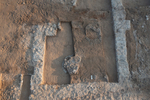
Room 2 (Figs. 6, 7). The room (Fig. 4: Section 7-7) was delineated on the east and west by two parallel walls (W167, W181) built of two rows of medium and large hewn stones and on the north by a pillar (L198; 0.87 × 1.00 m). Inside the room, there were two irregularly shaped hearths (L200, L201) containing ash, and above them there was a cluster of small and medium-sized fieldstones. A pillar built of hewn stones (L199; 0.30 × 0.68 m) was integrated into the eastern face of W167. The northern part of W167 continued beyond the boundaries of the room, and its northern end abutted the wall (W168) that delineated the well. From the south, Walls 167 and 181 were abutted by a massive bedding (L178; 6.3 × 7.3 m) for a square courtyard floor. The bedding was constructed of small and medium-sized fieldstones bonded with grayish mortar.
Room 3 (Fig. 8). Walls delineated the room on the north, east and west (W167, W177, W179, W193; Fig. 4: Sections 5-5, 6-6). Walls 177 and 193 were built from a row of small and medium-sized fieldstones bonded with reddish mortar, while Walls 167 and 177 were wider and built from two rows of stones. In the northern end of the room, a floor (L197) of small fragments of kurkar packed with sand was exposed.
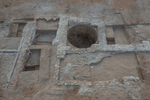
Well 165 (Fig. 8). The well (diam. 3.75 m, excavated depth 6 m; Fig. 4: Sections 5-5, 6-6) is large in comparison to most of the wells known in the area, although a few wells with a similar diameter were found (Arbel 2017). The well was excavated manually down to a depth of 0.5 m, and from there excavation continued using mechanical equipment. Twelve courses of ashlar lining (0.25 × 0.35 m on average) coated with grayish plaster were exposed. Evidence of burning was identified on the western wall of the well. Based on the depth of the local water table, the original depth of the well was probably c. 20 m. The well’s lower part may have been hewn into bedrock, like other wells in the area. The opening of the well was surrounded by four walls (W164, W166, W168, W179), which had two faces of large rectangular hewn stones bonded with grayish mortar. Pillars (L194–L196; c. 0.35 × 0.75 m on average), which were likely the base of a vaulted ceiling, were discovered in three of the corners of the square building. Inside and besides the well, there was refuse (L139, L159, L160), including pottery, glass and metal that date the final use of the well and the orchard to the end of the British Mandate.
Reservoir 176 (Figs. 8, 9). The reservoir (vol. 5.7 cu m) was dug into the ground between the well and Canal 109 and plastered with gray hydraulic plaster (side thickness 8 cm). The southern and northern sides and small segments of the floor adjacent to the sides were preserved. The southern side of the reservoir abutted the northern side of the well, and its northern side abutted the foundation of Canal 109.
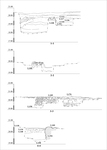
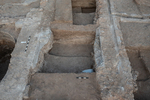
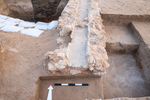
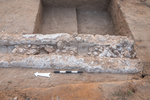
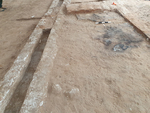
Irrigation Canals 108 and 109 (Fig. 10). The two canals were perpendicular to one another and built on a bedding of medium-sized fieldstones bonded with reddish mortar and covered with gray hydraulic plaster. Canal 109 (exposed length 8.3 m, external width 1.1 m, internal width 0.25 m; Fig. 3: Sections 3-3, 4-4; Fig. 4: Section 5-5) was built on an east–west axis, and it sloped from east to west. Pottery sherds were exposed at the bottom of the canal, attesting to repairs. The southern wall of the canals was about 0.2 m wider and 0.6 m taller than the northern one.
Canal 108 (exposed length 30 m, average external width 0.8 m, average internal width 0.3 m; Fig. 3: Sections 1-1, 2-2) was built on a north–south axis, and it joined Canal 109 from the north. Canal 108 sloped from south to north. Two barriers that regulated the water flow were exposed in the canal, about 12.4 m apart (Fig. 11). The barriers were built of small stones that were bonded and coated with gray plaster.
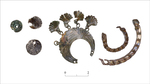
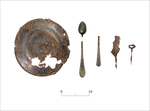
The two canals were found filled with soil and refuse, except for two segments of Canal 108 that were blocked with small fieldstones (Fig. 12). It appears that water from Canal 109 flowed into Canal 108, and from there to the nearby orchards. East and west of Canal 108, burnt layers (L119–L121; Figs. 13, 14) were exposed, which may date to the final phase of the orchard. Metal artifacts, including jewelry and tableware, were discovered inside and along the canals (Figs. 15, 16).
The Pottery Finds
Peter Gendelman
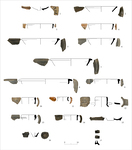
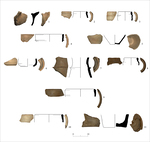
The excavation uncovered pottery fragments from the late Ottoman period and the British Mandate, including glazed vessels, Black Gaza Ware, a cooking pot, jars, jugs, saqiye vessels, water pipes and a flowerpot.
Glazed Vessels. Fragments of local and imported glazed bowls and an imported glazed jug were found. The imported bowls include one manufactured in Çanakkale in northwestern Turkey (Fig. 17:1), during the second half of the nineteenth century CE, and one manufactured in Didymoteicho in eastern Greece (Fig. 17:2), during the second half of the nineteenth and the early twentieth centuries CE. The local glazed bowls (Fig. 17:3, 4) date to the second half of the nineteenth and early twentieth centuries CE. The glazed jug fragment (Fig. 17:11) is reminiscent of vessels manufactured in southern France during the second half of the nineteenth and the early twentieth centuries CE.
Black Gaza Ware. This group of vessels is characterized by dark gray fabric and includes large bowls (Fig. 17:5–9), jars (Fig. 17:10) and jugs (Fig. 17:12–17). The ware was manufactured in workshops along the southern coastal plain from the eighteenth–twentieth centuries CE (Israel 2006:23–35).
Cooking Pot. A fragment of a large, globular, handmade pot (Fig. 18:1), with a crescent-shaped handle attached to the shoulder, was found. These vessels first appeared during the Mamluk period, and they continued to be used in the Ottoman period.
Jars. Two types of jars were found, one with a simple rim (Fig. 18:2) and the other with a ridge on its neck (Fig. 18:3, 4).
Jugs. Two jugs were found, one local (Fig. 18:5) and the other imported (Fig. 18:6).
Saqiye Vessels, Water Pipes and a Flowerpot. Saqiye vessels (Fig. 18:7) and clay water pipes (Fig. 18:8–10) were found. These were probably associated with the operation of the irrigation system. A clay flowerpot was also found (Fig. 18:11).
The Glass Finds
Yael Gorin-Rosen
One hundred and sixty-three glass fragments were found, including mostly body sherds of late nineteenth and twentieth centuries CE vessels (126). The remainder (37) are identifiable glass vessel fragments, beads and bracelets. A chunk of raw glass was also found.
The glass vessels include fragments of soft drink, wine, beer and medicine bottles, as well as colorless household vessels. One fragment (L102), belonging to a brown glass beer bottle, has a partially preserved embossed inscription on its base: O.N.S. BREWING. A few colored-glass body fragments were found, including one of transparent pinkish glass, one of opaque-milky turquoise glass and several mold-made fragments with geometric and vegetal motifs. Fragments of thick and thin industrial glass windows were also found. Presumably, the vessels and window panes were used in the building that was exposed during the excavation.
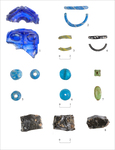
One notable find is a shoulder fragment from an unusual industrially manufactured blue-glass vessel (Fig. 19:1). The vessel is decorated with a pattern designed to imitate wheel-cut crystal. The fragment is probably from a narrow-necked bottle or vase with a hexagonal body. The body facets are decorated with bands of rectangles, each bearing a raised geometric motif; these bands are separated by narrow plain rectangles. The uppermost rectangle band features a raised oval motif, while the band beneath it has a raised rectangular motif. The wall thickness varies across the vessel.
Additionally, there are two fragments of twisted bracelets made of two glass trails in different hues twisted together. One bracelet (Fig. 19:2) is made of turquoise glass, decorated with a fine white trail spaced at wide intervals. The other bracelet (Fig. 19:3) is made of greenish glass, and it is very worn. The bracelet is decorated with a wide yellow trail, twisted in varying intervals. These bracelets are common over a long period and vary in the quality of material and manufacture. Similar bracelets were found in the Qishle Compound in Yafo, which was dated to the Ottoman period from the eighteenth–nineteenth centuries CE (Vincenz 2021a:444, 446, Fig. 19.1:4–6).
Another fragment belongs to an unusual bracelet (Fig. 19:4) made of dark glass that looks black. It is decorated with opaque white glass that was applied while hot and shaped into asymmetrical drops, embedded into the surface of the bracelet. Where the white glass weathered away, shallow depressions remain. The bracelet has a D-shaped cross-section. Although similarly decorated bracelets are unknown from late assemblages from sites previously excavated in Yafo and Jerusalem, this bracelet is presumably contemporary with the other bracelets recovered in the excavation.
The beads include two glass beads and one plastic bead. The two glass beads are made of turquoise glass. One is of non-homogeneous glass; it is oblate and has a wide perforation (Fig. 19:5), suggesting that it was handmade. In contrast, the other is round with a narrow perforation and uniform finishing and shaping; therefore, it was likely industrially manufactured. Both are characteristic of prayer beads (misbaḥa). The use of turquoise or light blue beads was very common in the Middle East, and they were attributed various magical properties. Similar beads were found in many excavations, although only a few were published. Recently, four such beads were recovered during an excavation near Gan Yavne and dated to the Ottoman period (Hoofien 2023: Figs. 19, 20). The third bead is made of greenish-grayish plastic (Fig. 19:7). Its shape and the remnants of excess material around the perforation are typical of industrial production of low-quality plastic beads.
The raw chunk of glass is dark (Fig. 19:8), although the hue of the class is unclear. The chunk is irregular, with a square outline and a trapezoidal section. The surface on one side has various-sized depressions, some covered with sandy encrustations. A large concentration of dark greenish chunks of various sizes was found on the surface in an excavation at Qula, without any glass vessels or artifacts; these may be waste from a modern factory that was located nearby (Ouahnouna 2022: Fig. 25). Similarly, the chunk that was found in this excavation may belong to a local industry from the first half of the twentieth century CE, prior to the establishment of the neighborhood.
Animal bones
Midori Intrator
A few animal bones were discovered in the excavation, of which 21 bones were identified (Appendix 1), originating from assemblages of the Ottoman period and the British Mandate. They were collected by hand and sealed in paper bags. The identification of the bones was done utilizing the comparative collection from the Laboratory of Archaeozoology at the University of Haifa. Identifiable bones were recorded following the methods outlined by Lyman (2008).
The assemblage includes 17 goat/sheep bones (81% of the assemblage; Capra/Ovis), one camel bone (4.8% of the assemblage; Camelus dromedarius) and three bones unidentifiable to the species level and categorized as medium-sized mammals (14.2% of the assemblage).
Surface examination of the bones revealed that the bones were not exposed to fire or weather damage, suggesting that they were swiftly buried and not left exposed to the elements. Evidence of gnawing by predators was observed on three of the goat/sheep bones, and on two of the bones, one from a goat/sheep and the other from a medium-sized mammal, butchering marks were observed.
Conclusion
The remains of the orchard that were uncovered in the excavation represent an integral part of the rural-agricultural hinterland of Yafo during the Ottoman period and the British Mandate, and this excavation joins numerous excavations in the area that elucidated the orcharding system. Remains of an orchard were exposed in the excavation, including the walls of buildings, a well, a reservoir and irrigation canals. Pottery sherds dated to the late Ottoman period and the British Mandate were found; these include local vessels and Gaza Ware with a dark gray fabric, common to this period. Glass fragments and metal waste were also recovered. Layers of soil from agricultural plots were uncovered in the excavation. The uppermost soil layer served as a football field during the final use of the site, prior to the present excavation.
The orchard complex extended on both sides of an east–west road, which led westward to the Russian Church and Sabil Abu Nabbut. On both sides of the road were orchards whose boundaries appear on maps. Dozens of these complexes were in the area, situated within orchards and alongside the roads. The excavated orchard complex was probably destroyed at the end of the British Mandate. Over its area north of the road and across the adjacent agricultural fields, the football field of the Gadna Tel Aviv Yehuda Football Club was established and used until recently when the land was rezoned for other municipal purposes.
References
Ajami M. 2006. Yafo (Jaffa), Qibbuẕ Galuyot Street. HA–ESI 118. https://doi.org/10.69704/jhaesi.116.2004.334
Arbel Y. 2017. Tel Aviv, Herzl Street. HA–ESI 129. https://doi.org/10.69704/jhaesi.116.2004.25354
Arbel Y. and Rauchberger L. 2015. Yafo, Magen Avraham Compound. HA–ESI 127. https://doi.org/10.69704/jhaesi.116.2004.23799
Avissar M. 2005. The Pottery. In M. Avissar. Tel Yoqne‘am: Excavations on the Acropolis (IAA Reports 25). Jerusalem. Pp. 35–78. https://doi.org/10.69704/iaarepv000.1996.53
Boas J.A. 2000. Pottery and Small Finds from the Late Ottoman Village and the Early Zionist Settlement. In Y. Hirschfeld. Ramat Hanadiv Excavations: Final Report of the 1984–1988 Seasons. Jerusalem. Pp. 547–580.
Dagot A. 2019. Tel Aviv, Herzl Street. HA–ESI 131. https://doi.org/10.69704/jhaesi.116.2004.25668
Dayan A., Golan D. and Arbel Y. 2021. Remains from Middle Bronze Age II and the Byzantine, Early Islamic and Ottoman Periods at Bene Beraq. ‘Atiqot 104:33*–66* (Hebrew; English summary, pp. 241–243). https://doi.org/10.70967/2948-040X.1916
Golani A. 2005. Salvage Excavations in the Modi‘in Landscape. ‘Atiqot 50:73–97. https://doi.org/10.70967/2948-040X.1167
Gorzalczany A. 2008. Yafo. HA–ESI 120. https://doi.org/10.69704/jhaesi.116.2004.888
Hoofien R. 2023. Glass Beads. In. I. Radashkovsky, Gan Yavne, Barqa. HA–ESI 135. https://doi.org/10.69704/jhaesi.116.2004.26289
Israel Y.M. 2006. The Black Gaza Ware from the Ottoman Period. Ph.D. diss. Ben-Gurion University of the Negev. Be’er Sheva‘ (Hebrew; English summary, pp. IV–XII).
Kletter R. 2004. Jaffa, Roslan Street. ʻAtiqot 47:193−207. https://doi.org/10.70967/2948-040X.2190
Moshe R. 2019a. Yafo, Abu Kabir. HA–ESI 131. https://doi.org/10.69704/jhaesi.116.2004.25580
Moshe R. 2019b. Yafo, Abu Kabir. HA–ESI 131. https://doi.org/10.69704/jhaesi.116.2004.25586
Ouahnouna B. 2022. Glass Finds. In L. Nadav-Ziv. Qula. HA–ESI 134. https://doi.org/10.69704/jhaesi.116.2004.26223
Rauchberger L. 2012. Yafo, Ganor Compound. HA–ESI 124. https://doi.org/10.69704/jhaesi.116.2004.2001
Rauchberger L. 2015. Yafo, the Postal Compound. HA–ESI 127. https://doi.org/10.69704/jhaesi.116.2004.20764
Sasson A. 2009. Biara and Orchard Houses in Jaffa and its Environs. In M. Zur and S. Rotbard eds. Neither in Jaffa nor in Tel Aviv: Stories, Testimonies and Documents from Shapira Neighborhood. Tel Aviv. Pp. 59–70 (Hebrew).
Shacham Z. 2011. Jaffa in Historical Maps (1799–1948). In M. Peilstöcker and A.A. Burke eds. The History and Archaeology of Jaffa 1 (The Jaffa Cultural Heritage Project Series 1; Monumenta archaeologica 26). Los Angeles. Pp. 137–174. https://doi.org/10.2307/j.ctvdjrrkm.19
Stern E.J. 2016. The Ceramic Finds from the Ottoman Flour Mills in the Ridwan Gardens, ‘Akko. ‘Atiqot 87:83–96. https://doi.org/10.70967/2948-040X.1783
Ustinova Y. and Nachshoni P. 1994. Excavations in Ramot Nof, Be’er Sheba. ‘Atiqot 25:157–177.
Vincenz A. de. 2019a. The Ceramic Assemblage from Kefar Gabirol, el-Qubeibe. ‘Atiqot 96:171–198. https://doi.org/10.70967/2948-040X.2049
Vincenz A. de. 2019b. The Late Ottoman-Period Pottery from Kafr ‘Ana, Or Yehuda. ‘Atiqot 95:219–227. https://doi.org/10.70967/2948-040X.2074
Vincenz A. de. 2020a. Byzantine- and Ottoman-Period Pottery Assemblages from Rabbi Yehuda Me-Raguza Street, Yafo (Jaffa). ʻAtiqot 100:75–119. https://doi.org/10.70967/2948-040X.2086
Vincenz A. de. 2020b. Ceramic and Porcelain Vessels of the Ottoman Period from the French School on Yefet Street, Yafo (Jaffa). ʻAtiqot 100:497–512. https://doi.org/10.70967/2948-040X.2123
Vincenz A. de. 2020c. Ottoman-Period Ceramic Artifacts from the Magen Avraham Compound, Yafo (Jaffa). ‘Atiqot 100:293–347. https://doi.org/10.70967/2948-040X.2107
Vincenz A. de. 2021a. Glass Bracelets and Beads. In Y. Arbel ed. Excavations at the Ottoman Military Compound (Qishle) in Jaffa, 2007, 2009 (The Jaffa Cultural Heritage Project Series 4; Ägypten und Altes Testament 91). Münster. Pp. 443– 457.
Vincenz A. de 2021b. Porcelain and Ceramic Vessels of the Ottoman Period. In Y. Arbel ed. Excavations at the Ottoman Military Compound (Qishle) of Jaffa (Ägypten und Altes Testament 91). Münster. Pp. 127–304.
Keywords
Citrus orchard, orchard complex, Saqiye well, reservoir, irrigation canal system, late Ottoman period, British Mandate, rural-agricultural area
Publication Date
07/09/2026
Link to Excavation Repository
Report Type
Final Report