
Tel ‘Arad (Northeast) (A-9598)
Permit/License Number
A-9598
Excavation Report
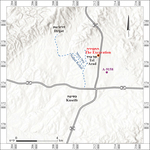
During June 2023, a salvage excavation was conducted about 250 m northeast of Tel ‘Arad (Permit No. A-9598; map ref. 21228/57675–6; Fig. 1), following the discovery of clusters of stones in probes that were conducted on the planned route of a water line. The excavation, on behalf of the Israel Antiquities Authority and funded by the Authority for Development and Settlement of the Bedouin in the Negev, was directed by N.S. Paran, with the assistance of Y. Alamor (administration), D. Biton (area supervision), A. Montagu (surveying and drafting), E. Bischoff-Bruintjes (probes), Y. Abadi-Reiss (flint), Y. Nagar (physical anthropology), D. Eisenberg-Degen (consultancy and scientific guidance) and F. Kobrin and S. Talis from the IAA Southern Region.
Numerous excavations were conducted at Tel ‘Arad, and remains of an Early Bronze Age city, an Iron Age fortresses, water reservoirs and their drainage systems were exposed (Amiran 1978; Amiran et al. 1997; Herzog 2002; Talis 2015; 2020; License Nos. G-46/2005, G-47/2007, G23/2008, G-55/2009, G-45/2011). The current excavation is the first in this particular area. Seven, probably Muslim, pit graves were discovered.
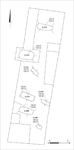
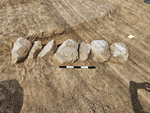
Pottery from the Early Bronze Age and the Iron Age and a few flint items were visible on the surface before the excavation. After clearing the area with mechanical equipment, the clusters of stones identified in the probes (depth 0.3–0.7 m) were revealed, and excavations clarified that these covered graves. The excavation uncovered seven pit graves (L104, L108, L109, L111–L114; Fig. 2) dug into hard sterile loess soil in an approximately east–west orientation and covered with a row of fieldstones (Fig. 3). Graves 104, 109 and 112 (length 0.6–1.0 m, width c. 0.3 m) are shorter than Graves 108, 111, 113 and 114 (length 1.5–1.8 m, width 0.4–0.8 m), and in all graves there was soft soil.
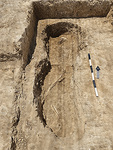
No bones were found in the three short graves (Graves 104, 109 and 112) perhaps because they were infant burials, and the skeletons did not survive. Poorly preserved human bones were found in the long graves (Graves 108, 111, 113 and 114). The bones were examined on site and then reburied. Remains of four individuals were identified; they were interred individually in a primary burial. The deceased were laid on their right sides and oriented approximately east–west, with their heads to the west and their legs flexed, as is typical in Muslim burials (Fig. 4; Gorzalczany 2007). Judging by the dental wear and the fusion of the epiphyses of the long bones, all the interred individuals are adults, between 18–50 years old (Hillson 1986:176–201; Johnston and Zimmer 1989). Based on the femur measurements, the oldest individual was identified as a male (Bass 2005:230); biological sex could not be estimated for the remaining deceased.
The finds in the graves and their vicinity included a small amount of unworked flint and worn pottery sherds. These sherds date to the Early Bronze Age and Iron Age, the two occupation periods previously discovered at Tel ‘Arad, suggesting that they originated from soil in these layers that was used to cover the burials.
The absence of graves goods hinders dating the graves, but based on the characteristics of the graves and the burials, these may be the graves of Bedouins from recent centuries.
References
Amiran R., Ilan O., Sebbane M. and Herzog Z. 1997. Arad. Tel Aviv (Hebrew).
Amiran R. 1978. Early Arad I: The Chalcolithic Settlement and Early Bronze City; First–Fifth Seasons of Excavations, 1962–1966 (Judean Desert Studies). Jerusalem.
Bass W.M. 2005. Human Osteology. A Laboratory and Field Manual (5th edition). Columbia, MI.
Gorzalczany A. 2007. The Kefar Saba Cemetery and Differences in Orientation of Late Islamic Burials from Israel/Palestine. Levant 39:71–79. https://doi.org/10.1179/lev.2007.39.1.71
Herzog Z. 2002. The Fortress Mound at Tel Arad: An Interim Report. Tel Aviv 29:3–109. https://doi.org/10.1179/tav.2002.2002.1.3
Hillson S. 1986. Teeth. Cambridge, U.K.
Johnston F.E. and Zimmer L.O. 1989. Assessment of Growth and Age in the Immature Skeleton. New York.
Talis S. 2015. Tel ‘Arad. HA–ESI 127. https://doi.org/10.69704/jhaesi.116.2004.22788
Talis S. 2020. Tel Arad. HA–ESI 132. https://doi.org/10.69704/jhaesi.116.2004.25799
Keywords
Tel ‘Arad, Early Bronze Age, Iron Age, fortresses, water reservoirs, Muslim pit graves
Publication Date
07/09/2026
Link to Excavation Repository
Report Type
Final Report