
Aḥihud (A-6895)
Permit/License Number
A-6895
Excavation Report
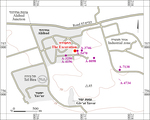
During September 2013, a salvage excavation was conducted in the eastern part of Moshav Aḥihud (Permit No. A-6895; map ref. 216779–93/756884–98; Fig. 1), prior to its expansion. The excavation, on behalf of the Israel Antiquities Authority, was directed by R. Abu Raya, with the assistance of Y. Ya‘aqobi (administration), A. Shapiro (GPS), R. Mishayev and M. Kahan (surveying and drafting), Y. Gorin-Rosen (glass), A. Ganor (glass restoration), H. Tahan-Rosen (pottery and glass drawing), C. Amit (glass and metal finds drawing) and N. Marom (zooarchaeology).
The excavation area (48 sq m) was opened on a limestone hill, and meager remains of a Byzantine–early Umayyad period-building were found. Above the building remains was a destruction layer with pottery, glass fragments, coins, a bronze item and animal bones, which were dated to the Roman and late Byzantine–early Umayyad periods. About 100 m east of the building, a refuse pit containing numerous pottery vessels from the late Byzantine period was uncovered.
Adjacent to the excavation on the east, a large Byzantine-period oil press (Fig. 1: A-5470) was discovered. Surveys and excavations in the vicinity uncovered remains of buildings, quarries and agricultural installations of a settlement, which was founded during the Roman period and reached its zenith during the Byzantine period; over it, the village of el-Birwa was established and later abandoned in 1948 (Cohen 2007 [Fig. 1: A-3250]; Cohen 2008 [Fig. 1: A-4196]; Avshalom Gorni 2009; Porat and Getzov 2010 [Fig. 1: A-3746]; Abu Raya 2010 [Fig. 1: A-4734]; Spivak 2019 [Fig. 1: A-8098]; Abu Raya 2020 [Fig. 1: A-7138]).
Building Remains (Figs. 2–4)
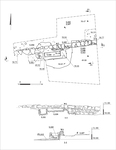
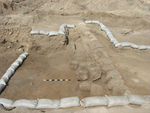
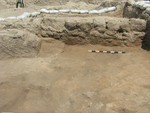
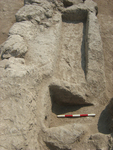
A segment of an ashlar wall (W1; length 8 m, width 0.5 m) that was founded on bedrock was uncovered. North of the wall, excavations uncovered a crushed lime floor (L107; thickness c. 0.1 m), which was cut when the foundation trench of the wall was dug. South of the wall, another floor (L112), 0.4 m lower than Floor 107, was exposed. The eastern part of Floor 112 abuts the wall and was made of crushed lime, while its western part was hewn into the bedrock and contains two adjacent rectangular troughs (L110, L111; Fig. 5) that were also hewn into the bedrock. Trough 110 (c. 0.4 × 1.5 m, depth 0.3 m) was oriented east–west, and a tethering hole was formed in its southern side. Trough 111 (exposed surface c. 0.5 × 0.5 m, depth 0.5 m) was oriented north–south and was partially exposed. Two holes were uncovered in its western side; the lower was probably a drainage hole, and the upper was probably a tethering hole.
Above and flanking the remains of the wall are heaps of collapsed large ashlars (max. measurements 0.5 × 0.6 × 0.7 m) and a thick accumulation of ash, indicating a destruction event (L102–L105, L108). Few pottery sherds dating to the Roman and late Byzantine periods and numerous Umayyad-period sherds were found in the destruction layer and on the surface (L101).
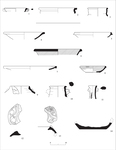
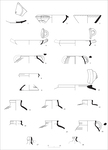
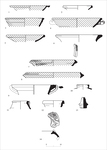
Among the Roman pottery, there is a Late Roman cooking bowl (Fig. 6:1) and a Middle-Roman krater and jar (Fig. 6:2, 3). The pottery from the late Byzantine period (sixth–early seventh centuries CE) consists primarily of imports, including bowls from Phocaea, Turkey (Fig. 6:4–6), a bowl from North Africa (Fig. 6:7), a Cypriot bowl (Fig. 6:8), a Gaza jar (Fig. 6:9) and two amphorae that were imported from the Aegean Sea region (Fig. 6:10, 11). There are also three sherds of locally manufactured Phoenician oil lamps (Fig. 6:12–14). The vessels forms are common at late Byzantine period sites in the Western Galilee. The Umayyad-period pottery includes bowls, among them a base of an imported bowl from Egypt (Fig. 7:1) and two local bowls, one with a pinched rim (Fig. 7:2) and the other handmade (Fig. 7:3); cooking wares, including casseroles (Fig. 7:4, 5), cooking pots with a low (Fig. 7:6, 7) or tall angular rim (Fig. 7:8) and a simple lid (Fig. 7:9); fragments of pithos (Fig. 7:10) with a thick rim and holemouth; four types of jars: long-necked with a folded rim (Fig. 7:11), long-necked with a simple rim (Fig. 7:12), short-necked with a simple rim (Fig. 7:13, 14) and short necked with a folded rim (Fig. 7:15); a jug with wide orifice (Fig. 7:16); and two types of flasks, one with simple rim (Fig. 7:17) and the other with flat rim (Fig. 7:18). Fragments of bricks and tiles were also found. These types of pottery are known from sites in the Western Galilee dating to the seventh century CE.
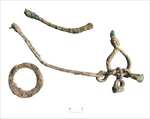
Fragments of glass vessels from late Byzantine and early Umayyad periods were also found in the destruction layer, as well as chunks of raw glass (below) and numerous animal bones (below). Two poorly preserved Byzantine-period coins were found in the top levels of this layer. At the bottom of the layer in a heap of collapsed stones on the floor, parts of a bronze hanging device for a glass oil lamp (Fig. 8) were found.
Refuse Pit
A large quantity of pottery sherds dated to the late Byzantine period (sixth and early seventy centuries CE) was found in the pit. These include numerous bowls imported from Egypt (Fig. 9:1), Phocaea, Turkey (Fig. 9:2) and Cyprus (Fig. 9:3–9), a local jar (Fig. 9:10), a jar from Gaza (Fig. 9:11) and an amphora (Fig. 9:12) and amphora stopper (Fig. 9:13), imported from the Aegean Sea region.
The Glass Assemblage
Yael Gorin-Rosen
A large quantity of glass vessels, relative to the excavated area, and production debris were found in the excavation. Other excavations nearby in Aḥihud also uncovered extensive production debris (Fig. 1: A-5470) and similar vessel forms (Porat and Getzov 2010 [Fig. 1: A-3746]). The homogeneity of the vessel forms, the quality of material and the production method indicates that these vessels were probably made in a local workshop.
About 200 identifiable fragments were found, half from L103, and they include bowls, wineglasses, bottles and oil lamps. All the vessels that were found in this excavation are dated to the late Byzantine and early Umayyad periods (end of the sixth century and seventh centuries CE). The vessels are very similar to the ones that were found in the excavation of et-Ṭuweiri, next to Kibbutz Sa‘ar in the Western Galilee, where they were dated to the late Byzantine and beginning of Early Islamic periods (Gorin-Rosen 2024:307 and see references therein).
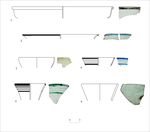
Bowls. The vessels include a few simple bowls with upright rims or out-turned rims that are folded out and downward (Fig. 10:1). These forms were common during the Late Roman and early Byzantine periods, and the last ones produced in this style date to the late Byzantine and early Umayyad periods (e.g. a bowl from et-Ṭuweiri; Gorin-Rosen 2024:308, Fig. 1:1). One bowl was decorated with a blue trail on the edge of the out-turned rim (Fig. 10:2), using a decoration style that was more common on beakers/bowls, wineglasses and bottles during this time span (see below).
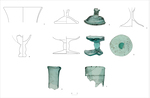
Wineglasses. A few rims and bases of wineglasses were found. The rims were rounded and thickened in the fire, with no decoration, and made from light yellowish-green glass (Fig. 10:3) or more commonly light greenish-blue glass (Fig. 11:1). Rims of wineglasses decorated with darker trails were also found, including one decorated with blue trails and one decorated with turquoise trails on and below the rim (Fig. 10:4, 5 respectively). Similarly decorated wineglasses were found at et-Ṭuweiri (Gorin-Rosen 2024:308–310, Fig. 1:3, 4, and see therein references to Khirbat el-Shubeika in the Western Galilee, Ẓippori, Bet She’an and Jerusalem). The most diagnostic fragments of these wineglasses are the bases, which feature a stem to hold the glass. At least four different types of bases were recovered during the excavation. The first, simplest and most common type is a hollow ring base. Several fragments of this type were found, one of which (Fig. 11:2) bears tooling marks on the base near the stem. A few bases with similar tooling marks were found in excavations in the Western Galilee, including two from a salvage excavation at Ḥorbat ‘Emed, north of Aḥihud (Gorin-Rosen 2021:1–3, Fig. 1:2 and see references therein to a similar base from Ḥorbat Ofrat in the Lower Galilee). The second type is a thin delicate base with a very fine stem (Fig. 11:3). Similar wine glasses are rare, and examples were so far found only at Khirbat el-Batiya in the Upper Galilee, a glass vessel workshop in Beirut and Caesarea (Gorin-Rosen 2006:*31, Fig. 1:6). The third type is a solid and thickened cylindrical wineglass stem (Fig. 11:4). The fragment that was found in the excavation has a rare olive-greenish hue. The body of the wineglass is narrow and ovoid. The fourth type is more common; it is a thickened cylindrical stem (Fig. 11:5). From this type, excavations uncovered a solid base with tooling marks. Most of these wineglass types are known from excavations throughout Israel in assemblages dated to the late Byzantine and early Umayyad periods (see discussion of the types mentioned above in Khirbat al-Batiya [Gorin-Rosen 2006:*29–*32, Fig. 1:3–10], et-Ṭuweiri [Gorin-Rosen 2024:308–310, Fig. 1:5–8] and ‘Akko [Gorin-Rosen 2023:183, Fig. 9.1:1–3]).
Bottles. A few fragments of bottles were found: a bottle with a thickened rim flared outward forming a funnel (Fig. 10:6), a bottle with an upright and partly rounded folded in rim with a relatively narrow neck (Fig. 11:6) and a bottle with an upright rounded rim decorated below the rim with horizontal trails in the same shade as the vessel (Fig. 11:7). Bottles similar to Nos. 6 and 7 were found at et-Ṭuweiri, Shave Ẓiyyon, Khirbat el-Shubeika, ‘Akko and other sites (Gorin-Rosen 2024:311–312, Fig. 2:1–3).
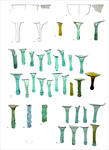
Oil lamps. The most common glass vessel type recovered in this excavation is a lamp featuring a solid stem with a thickened or beaded end (Fig. 12:4, 7, 9, 12, and most of the lamps in Fig. 12:8) or with several thickened knobs along the stem. At least 38 lamps of this type were found, and most are illustrated in Fig. 12. Only one lamp with a hollow base was found (Fig. 12:3, 8 [in No. 8, the leftmost specimen]). These lamps have rounded, thickened rims, similar to the wineglasses; therefore, they are difficult to differentiate. One rim (Fig. 12:1) was identified as a lamp based on its diameter. Another in-folded rim (Fig. 12:2) was identified as a lamp based on the curvature of the wall near the stem. Most lamps have one or two beads at the end of the stem; however, two examples have an entirely beaded stem (Fig. 12:10, 11), and one has no bead at its end (Fig. 12:6). The uniform fabric and workmanship of these lamps indicate that they were produced on a production line in a local workshop. Most of the lamps are made of greenish-blueish glass, while a few are made of olive-green or yellowish-brown glass (Fig. 12:5, 8). The hue of some lamps is not uniform (e.g., Fig. 12:7, 9, 11, 12 [in No. 12, the rightmost specimen]). The quality of the material and the hues are characteristic of glass vessels from the late Byzantine and Umayyad periods. Lamps of these types were also found at et-Ṭuweiri (Gorin-Rosen 2024:314–316, Fig. 4:1, 4, 5) and many other sites, including ‘Akko (Gorin-Rosen 2023:183–184, Fig. 9.1:4–6) and Ḥorbat ‘Emed (Gorin-Rosen 2021:3, Fig. 3:1).
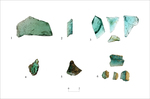
Chunks of Raw Glass. Clean chunks of raw glass (Fig. 13:1–3) and chunks with remains of furnace debris (Fig. 13:4, 5) were found with the vessels. Most of the debris was found in the destruction layer in L102, L103 and L108. The colors of the chunks are similar to the colors of the vessels: greenish-blue in various shades of lightness. No manufacturing debris was found apart from the chunks, and the furnace itself was probably not within the boundaries of the excavation. In Area D2 of an earlier excavation in Aḥihud, clean chunks and chunks with furnace debris were also found in association with vessels, including wineglasses similar to the ones found in the current excavation and solid beaded-stem lamps (Porat and Getzov 2010 [Fig. 1: A-3746]). This combination was also observed at et-Ṭuweiri (Gorin-Rosen 2024:318–319).
The glass vessels that were found in the current excavation were likely manufactured by a local workshop whose location has not yet been identified, but its remains were uncovered in various areas of the site. At least some of the lamps were used and placed in the bronze hanging device that was found in the excavation (see above). The lamps and wineglasses may have originated in a nearby, possibly public, building. The glass finds that were discovered in this excavation enhance the understanding of glass production at this site during the late Byzantine and early Umayyad periods.
Animal Bones
Nimrod Marom
A small assemblage (N=161) of animal bones from the late Byzantine period was found in the excavation. The bones were identified to body part and taxa using the reference collection of the zooarchaeology laboratory of the University of Haifa. Most of the bone fragments are of sheep/goat (N=110; 68%), which were found in similar frequencies: goats (N=8) and sheep (N=8). A small sample of bones with fused epiphyses (N=40) indicates that most of the goats and sheep were slaughtered as young adults, aged two to four years. This find is supported by the stage of tooth eruption and wear, which was documented in several mandibles (N=9). Two pelvis fragments belonging to male goats or deer were also identified. It seems that most of the sheep/goat bones are of young males that were bought from an outside source since adult females and very young males are not well represented in the assemblage. Cattle (N=27; 17%) and chickens (N=18; 12%) were found in relatively low frequency. Equid bones, probably donkeys (N=3), dogs (N=2) and fish (N=1) are rare.
The distribution of skeleton parts of the sheep/goat and cattle shows a fairly equal representation of all body parts. The butchery marks (N=31) show that skinning and a small part of butchering the sheep/goats was done with knives (N=11), while most of the butchery was done with heavy cleavers (N=20). Vertebrae were also found, cut primarily horizontally, indicating butchery was conducted on a surface or floor as is norm in domestic contexts rather than on the butcher’s hook. The long bones are particularly broken, suggesting that marrow was extracted.
A small portion of the bones display burning marks (N=12), carnivores gnawing marks (N=5) and significant erosion (N=4;). Some of the bones were broken when fresh (N=31) and some when dry (N=37). Dense bone fragments (N=13), such as the distal ends of humeri and tibiae, are found in the assemblage at a much higher frequency than the porous proximal ends of the same bones (N=13). Therefore, it seems that bone preservation was influenced by post-depositional processes, which damaged the bones in reverse proportion to their density. These observations reflect multiple depositional stages, including smashing the bones, quick burial and secondary breakage because of diagenetic processes.
The assemblage reflects meat consumption by a group of consumers that were not particularly affluent. This can be deduced from the limited range of species, the application of household slaughtering and the use of all body parts, including parts of the skeleton with little meat, such as the feet. The consumption pattern observed in the assemblage may fit, for example, small-scale agriculturalists or craftsmen, but because these originate from a destruction layer, the site’s economy cannot be reconstructed in full. Nonetheless, the modest assemblage from Aḥihud is important as it is the first assemblage from the rural hinterland of ‘Akko dating to the late Byzantine period.
Conclusion
The excavation uncovered a building covered by a destruction layer with heaps of collapsed ashlars and ash, indicating that it was destroyed by an intense conflagration. The large assemblage of pottery and glass vessels dates the building to the late Byzantine–early Umayyad periods. The glass assemblage, which includes numerous oil lamps, wineglasses and chunks of raw glass, indicates a glass industry operated nearby, reinforcing finds of previous excavations (see above). The faunal assemblage indicates that the animals were acquired by a population that was not well-off and did not raise animals. Such a population may have been comprised of specialized craftsmen involved in manufacturing glass. The absence of pig bones may be early evidence for adherence of Islamic laws in the Western Galilee.
References
Abu Raya R. 2010. Ahihud, Survey (B). HA–ESI 122. https://doi.org/10.69704/jhaesi.116.2004.1617
Abu Raya R. 2020. Ahihud (East). HA–ESI 132. https://doi.org/10.69704/jhaesi.116.2004.25711
Avshalom-Gorni D. 2009. Ahihud HA–ESI 121. https://doi.org/10.69704/jhaesi.116.2004.1268
Cohen M. 2007. Ahihud HA–ESI 119. https://doi.org/10.69704/jhaesi.116.2004.512
Cohen M. 2008. Ahihud HA–ESI 120. https://doi.org/10.69704/jhaesi.116.2004.722
Gorin-Rosen Y. 2006. The Glass Finds from Khirbat el-Batiya (Triangulation Spot 819). ‘Atiqot 53:*29–*36 (Hebrew). https://doi.org/10.70967/2948-040X.2515
Gorin-Rosen Y. 2021. Horbat ‘Emed: The Byzantine-Period Glass Assemblage. In H. Tahan-Rozen and M. Hartal. Horbat ‘Emed. HA–ESI 133 (Hebrew; English summary). https://doi.org/10.69704/jhaesi.116.2004.26093
Gorin-Rosen Y. 2023. The Hospitaller Compound: The Glass Finds. In. E. Stern and D. Syon. ‘Akko III/1: The 1991–1998 Excavations; The Late Periods: The Hospitaller Compound (IAA Reports 72). Jerusalem. Pp. 181–239. https://doi.org/10.69704/iaaRepV000.1996.01
Gorin-Rosen Y. 2024. Late Byzantine and Early Islamic Glass from et-Ṭuweiri: A Rural Site in Western Galilee. ‘Atiqot 114:307−322. https://doi.org/10.70967/2948-040X.1027
Porat L. and Getzov N. 2010 Ahihud. HA–ESI 122. https://doi.org/10.69704/jhaesi.116.2004.1414
Spivak. P. 2019. Ahihud. HA–ESI 131. https://doi.org/10.69704/jhaesi.116.2004.25657
Keywords
rural settlement, late Byzantine period, Umayyad period, glass production, glass workshop, glass lamps, glass-production waste, olive press, animal bones, building remains
Publication Date
06/10/2026
Link to Excavation Repository
Report Type
Final Report