
Ḥorbat Migdal Usha (A-9240)
Permit/License Number
A-9240
Excavation Report
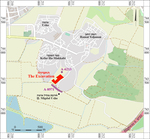
During February–March 2022, a trial excavation was conducted at Ḥorbat Migdal Usha, in Kibbutz Ramat Yoḥanan (Permit No. A-9240; map ref. 211147–356/743498–663; Fig. 1), prior to construction. The excavation, on behalf of the Israel Antiquities Authority and financed by Kibbutz Ramat Yoḥanan, was directed by A.S. Sa‘id (field photography), with the assistance of Y. Amrani and Z. Lotan (administration), S. Emmanuilov (photogrammetry and drafting), I. Reznitsky (metal laboratory), A. Dagot (location map), P. Gendelman (pottery), Y. Gorin-Rosen (glass), R. Lewis-Bloom (glass restoration), D. Gazit (glass photography), I. Lidsky-Reznikov (glass drawing), V. Eshed (physical anthropology), M. Shuiskaya (scanning and drawing finds) and workmen from Nablus.
In the Shefar‘am Map Survey, an Ottoman-period khan built from repurposed Crusader-period stones and, to its west, architectural remains and a hewn tomb, were recorded, and pottery from the Roman, Byzantine, Crusader, Mamluk and Ottoman periods was collected (Olami and Gal 2003: Site 85). Excavations in the vicinity uncovered primarily field walls and layers of stones from the Roman and Byzantine periods (Talmi 2012 [Fig. 1: A-6213]; Oren 2021 [Fig. 1: A-8571]).
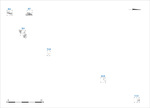
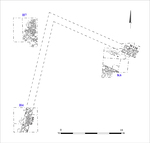
The present excavation was conducted on a hill sloping moderately westward, and six squares were opened (H4, H7, K6, N10, R18, U23; Fig. 2). Remains of a massive building and a working surface dated to the late Byzantine–Early Islamic periods (sixth–tenth centuries CE) were uncovered in the four southern squares. Three pit graves, which were probably part of an Ottoman-period Muslim cemetery, were exposed in the two northern squares (below, V. Eshed).
Square H4
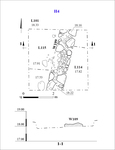
Excavations uncovered a massive wall (W109; width 1.1 m; Fig. 3), oriented northeast–southwest; only two courses were exposed. Wall 109 was built of various-sized fieldstones with a fill of soil and small stones between them. On the eastern face of the wall, there were remnants of brown plaster, mixed with small charcoal chunks and organic matter. Probes with mechanical equipment north of the square discovered that the wall continues c. 15 m farther northeast. Based on similarities in construction, it seems that W109 originally joined a wall that was oriented southeast–northwest, which was discovered in Square K6 (below, W110; Fig. 4); the two walls belonged to the same large building.
East of W109, there was an accumulation of soil (L114) mixed with pottery sherds, including an LRC bowl (Fig. 5:3) dated to the Byzantine period (sixth century CE) and a glazed bowl (Fig. 5:6) and bag-shaped jar (Fig. 5:9) dated to the Early Islamic period (eighth–tenth centuries CE). A few Ottoman-period and British Mandate pottery sherds (not drawn) were collected from the surface.
Square H7
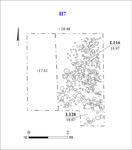
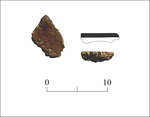
A layer of small and medium-sized fieldstones (L116; Fig. 6), covering about two thirds of the square’s surface, was uncovered. In an accumulation of soil between and above the fieldstones, a few pottery sherds dated to the Byzantine and Early Islamic periods (not drawn) were collected. This fieldstone layer may have been a working surface associated with the building whose remains were found to the east (see Fig. 4). Below the stone surface (L128), a fragment of a fresco was found (Basket 1048; Fig. 7); it likely dates to the Roman period, suggesting the site was also occupied during this period.
Square K6
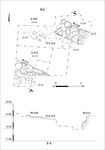
Two parallels walls, which were oriented southeast–northwest (W110 and W111; Fig. 8), were exposed. Wall 110 (exposed length 2 m, width 1.08 m) was built like W109 in Square H4 from various-sized fieldstones with a fill of soil and small stones between them; only a single course was preserved. A floor (L112) made of small stones and packed earth abutted the wall from the south. The wall and floor were damaged in the western part of the square by a modern pit. This floor may have continued westward and abutted W109 (see Fig. 4).
Excavations exposed only the northern face of W111 (height 0.7 m); it was built of large fieldstones with a fill of soil and small stones between them. In the southern part of the square and in the western section, a thin layer of black soil was found (L113; thickness 5 cm). In the northern section of the square, at a lower level, a similar black layer was exposed. These layers may be remnants of habitation levels, associated with the walls in this square. Pottery sherds, dated primarily to the end of the Byzantine and the beginning of the Early Islamic periods (fifth–seventh centuries CE) were found in Layer 113, north of W111, and include an LRD bowl (Fig. 5:2), a krater (Fig. 5:4; seventh century CE) and an amphora (Fig. 5:5; sixth–seventh centuries CE), as well as an Early Islamic-period jar (Fig. 5:10; eighth century CE). In the northern part of the square in a higher level of soil (L103), there were pottery sherds dating to the Early Islamic period (eighth–tenth centuries CE), including a krater (Fig. 5:8) and an oil lamp (Fig. 5:11).
Square N10
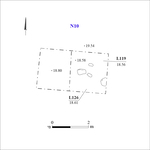
In the northern part of the square, a few stones and pottery sherds were found (L119; Fig. 9), including the rim of a bag-shaped jar (Fig. 5:1) from the Roman period (first century BCE–first century CE) and the base of a glazed bowl (Fig. 5:7) from the Early Islamic period (ninth–tenth centuries CE). An oil lamp (Fig. 5:12) from the Early Islamic period (the eighth–ninth centuries CE) was found in the southern part of the square (L126).
The Glass Finds
Yael Gorin-Rosen
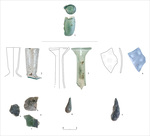
A small quantity of glass vessel fragments and production debris was collected. The glass vessel fragments date to two periods; one fragment dates to the Late Roman or early Byzantine period, while the rest dates to the Byzantine period, perhaps even to its end.
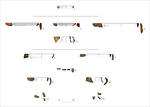
The Late Roman or early Byzantine period vessel fragment is part of a double kohl tube (Fig. 10:1). These vessels were common from the Late Roman period to the end of the Byzantine period. A complete double kohl tube, decorated with a wavy trail that forms handles on both sides, was found nearby in Qiryat Ata (Vitto 2008:146, Fig. 11:2), where it was dated to the second half of the fourth century CE, and in a tomb at Ḥorbat Ẓefat ‘Adi in northern Shefar‘am (for an extensive discussion and references to the Galilee and other regions in Israel, see Gorin-Rosen 2015:7–8, Fig. 3:19, 20).
The glass vessel fragments dated to the Byzantine period and perhaps to its end include three bottles (Fig. 10:2–4) that were found in a single basket in L114. Fragment Nos. 2 and 3 are rims of relatively small bottles. Bottle No. 2 has an upright rim and a cylindrical neck, narrowing at the joint with the shoulder. Bottles of this type are known from Byzantine assemblages, including the late Byzantine period, as well as the Umayyad period. Similar bottles were found in a tomb at Ḥorbat Ẓefat ‘Adi (Gorin-Rosen 2015:1, Fig. 1:1, 2 and see references therein to the Byzantine church at Shave Ẓiyyon, an early Byzantine tomb in Kabul, a church at Bet Yeraḥ dated to the sixth–seventh centuries CE and Ḥamat Gader). Bottle No. 3 has a short rim and a narrow elongated cylindrical neck. The rim was rounded in the fire and pressed onto a flat surface, creating a fine fold below the rim. This bottle is relatively small, and the rim is finely worked. Two base fragments were found with the two bottle rims. One is a small pushed-in base; its glass is similar to Bottle No. 3. The other is a fragment of a concave base of a medium-sized bottle made of greenish-bluish glass (not illustrated). Its shape is similar to the base of a bottle found at Ḥorbat Ẓefat ‘Adi (Gorin-Rosen 2015: Fig. 1:7). Fragment No. 4 belongs to a bottle decorated with shallow depressions at regular intervals on the wall. The pattern was produced using the ‘optic blown’ technique, in which a bottle is blown into a mold with the desired pattern, and after the pattern forms a relief on the surface, the bottle is placed into a round, smooth mold that embeds the relief into the wall. Through this technique, the pattern is visible but embedded inside the wall. Bottle No. 4 is made of transparent, nearly colorless glass with a particularly thin wall. These characteristics date the bottle to the end of the Byzantine or the Umayyad period.
The assemblage includes three glazed fragments of production debris (Fig. 10:5). Two may be pieces of kiln bricks that became glazed during firing (Fig. 10:5a, 5c). The third is a wall fragment coated with a thin layer of glass (Fig. 10:5b), which was probably part of a glass-melting pot or a crucible. Two glazed pendants (Fig. 10:6, 7) and a chunk of dark, vesicular waste (not photographed) that may be part of the glass or ceramic industry were also found.
The glass assemblage from the excavation suggests that there was a glass industry at the site. This is consistent with its location on the eastern side of the Zevulun Valley and Haifa Bay, a region where a flourishing glass industry operated during the Late Roman and Byzantine periods. Numerous discoveries on Mount Carmel and in its foothills support this hypothesis. These include finds from Jalama on the northern slopes of the Carmel Ridge (Gorin-Rosen 2021b), Horbat Usha, which yielded evidence for glass production during the Byzantine and early Umayyad periods (Gorin-Rosen 2021a and see references therein to Aḥihud and Ẓippori), and other sites in Akko and its surroundings.
The Anthropological Remains
Vered Eshed
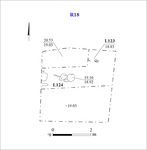
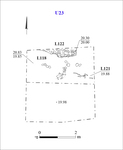
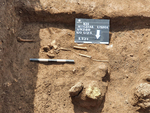
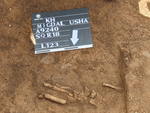
Graves in Squares R18 and U23. Three pit graves in an east–west orientation (L121, L123, L124; Figs. 11, 12) were found. Only Grave 124 had a cover stone. Each grave contained a single adult individual in primary burial with the head to the west, a position typical of Muslim burials. Therefore, the burials may be associated with a cemetery dated to the Ottoman period used by the occupants of the Arab village of el-Majdal.
From these burials, the bones that were found in both squares were poorly preserved. They were examined at the excavation area and left in situ.
The skeletal remains in Grave 121 (Fig. 13) were identified as female based on the vertical diameter of the femoral head (c. 39 mm; Bass 1987:219). The individual’s age at death is estimated to be over 40 years old, based on the upper and medial joint of the pelvis, which exhibit advanced age-related changes (Lovejoy et al. 1985).
The skeletal remains in Graves 123 and 124 (Fig. 14) were identified as male based on the vertical diameter of the femoral heads (49 and 50 mm, respectively; Bass 1987:219). The age ate death is estimated to be over 18 years old, based on the epiphyseal fusion in the femur (Johnston and Zimmer 1989).
Isolated Human Remains. Human skeletal remains, probably from the same Ottoman-period Muslim cemetery, were found in three loci (L114, L118, L126). The bones in L114 (Square H4) belong to an infant and include a fragment of a scapula and fibula, which is 87 mm long, excluding the epiphyses, a size suitable for an infant of 0.5–1.5 years old (Bass 1987:244). The bones in L118 (Square U23) include the tibia, femur, metatarsal and ulna of an individual over 18 years old, since the epiphyses of the femur are fused (Johnston and Zimmer 1989). The bones in L126 (Square N10) include fragments of an infant’s long bones and one complete femur without epiphyses. The femur length is appropriate for an infant of 0.5–1.5 years old (Bass 1987:217).
Summary
Part of a large building was uncovered in Squares H4 and K6, and it likely continued southward beyond the boundaries of the excavation. A working surface, which may be associated with the building, was uncovered in Square H7. These remains are dated to the Late Byzantine–Early Islamic periods (sixth–tenth centuries CE). Because of the limited scope of the excavation, it is not possible to assess the size and function of the building or determine if it was part of a settlement or just a solitary building. We suggest that this is a solitary building because remains from these periods were not found in the nearby excavation or in the survey. Pit graves were found in Squares R18 and U23, and they were perhaps part of the Ottoman-period cemetery of the Arab village of el-Majdal.
References
Bass W.M. 1987. Human Osteology: A Laboratory and Field Manual (3th edition). Columbia.
Gorin-Rosen Y. 2015. The Glass Finds from Ḥorbat Ẓefat ‘Adi (East). In H. Smithline ed. Ḥorbat Ẓefat ‘Adi (East). HA-ESI 127. https://doi.org/10.69704/jhaesi.116.2004.24890b
Gorin-Rosen Y. 2021a. H̱orbat Usha, Glass finds. HA–ESI 133. https://doi.org/10.69704/jhaesi.116.2004.26029
Gorin-Rosen Y. 2021b. Wind, Sea, Sand and Fire: The Height of the Glass Industry at the Foot of Mount Carmel. In S. Dar ed. ‘As Carmel by the Sea’: Archaeological and Historical Studies of Mt. Carmel and Its Environs. Pp. 108–136 (Hebrew).
Johnston F.E. and Zimmer L.O. 1989. Assessment of Growth and Age in the Immature Skeleton. In M.Y. Iscan and A.R. Kenneth eds. Reconstruction of Life from the Skeleton. New York. Pp. 11–21.
Lovejoy C.O., Meindl R.S., Prysbeck T.R. and Mensforth R.P. 1985. Chronological Metamorphosis of the Auricular Surface of the Ilium: A New Method for the Determination of Adult Skeletal Age at Death. AJPA 68:15–28. https://doi.org/10.1002/ajpa.1330680103
Olami Y. and Gal Z. 2003. Map of Shefar‘am (24) (Archaeological Survey of Israel). Jerusalem.
Oren E. 2021. H̱orbat Migdal Usha. HA–ESI 133. https://doi.org/10.69704/jhaesi.116.2004.26017
Talmi L. 2012. H̱orbat Migdal Usha. HA–ESI 124. https://doi.org/10.69704/jhaesi.116.2004.1934
Vitto F. 2008. A Late Third–Fourth-Century CE Burial Cave at Remez Street, Qiryat Ata. ‘Atiqot 60:131–164. https://doi.org/10.70967/2948-040X.1227
Keywords
remains of a building, working surface, late Byzantine period, early Islamic period, pit graves, Muslim cemetery, Ottoman period, glassware, glass industry, Arab village of el-Majdal, anthropological find
Publication Date
07/10/2026
Link to Excavation Repository
Report Type
Final Report