
Ḥorbat ‘Anim (A-9473)
Permit/License Number
A-9473
Excavation Report
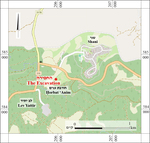
During March 2023, an excavation was conducted at Ḥorbat ‘Anim, near Yattir Forest (Permit No. A-9473; map ref. 206011–46/584557-89; Fig. 1), prior to developing the site and making it accessible for visitors. The excavation, on behalf of the Israel Antiquities Authority and funded by the Jewish National Fund, was directed by O. Shmueli with the assistance of Y. Alamor (administration), D. Gazit (field and studio photography), M. Kahan (surveying and drafting), Y. Shmidov (3D model), A. Moshe (health and safety), A. Cohen-Weinberger (petrography), K. Cytryn, U. ‘Ad and E. Ayalon (consultancy), Y. Bukengolts (pottery restoration), A. Shahar, A. Mashiah, R. Shoef, Y. Vaknin and A. Abd Salem (conservation) and Y. Schwartz and E. Aladjem (IAA public relations). Help was also rendered by M. Ajami, E. Nevo, O. Barzilai, S. Talis, F. Kobrin and D. Eisenberg-Degen from the IAA and Z. Ẓafon, N. Stern-Bibers, A. Lazar, A. Ginnat and A. Abuakean from the Jewish National Fund.
Ḥorbat ‘Anim is located in the Yattir region of the southern Hebron highlands. The site contains an Iron Age fortress, a Byzantine-period synagogue and dozens of hewn caves that served as dwellings during the Early Islamic, Mamluk and Ottoman periods (for an extensive survey of the research history, see Amit 2003:114–116). A prior excavation at the site uncovered two subterranean complexes: a rock-hewn cave, containing an olive oil press, and a vaulted building built inside a rock-hewn cavity (Shmueli and Amit 2014). Four strata were identified in the oil press cave, dating to the seventh–eighth centuries CE (Stratum IV), ninth–tenth centuries CE (Stratum III), thirteenth–fourteenth centuries CE (Stratum II) and nineteenth–first half of the twentieth centuries CE (Stratum I). The current excavation finished exposing the oil press and all related architectural elements.
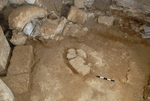
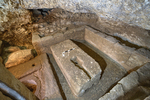
Stratum IV (seventh–eighth centuries CE). An open courtyard was hewn in front of the cave. It served as entrance to the cave, which was accessed via a staircase (Shmueli and Amit 2014: Figs. 2, 3). The oil press, which includes a crushing installation, an olive press and a working surface, was constructed during this time span. The crushing installation (Fig. 2) was partly uncovered in the northern part of the cave. The base of the crushing installation is a shallow depression that was hewn into the cave’s floor, in which a circular crushing basin was originally placed; the crushing basin was not preserved. A crushing stone was found next to the crushing installation base. A niche hewn into the ceiling above the crushing basin was used to anchor a vertical wooden beam, around which the crushing stone rotated.
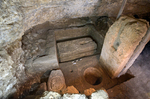
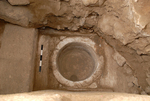
The pressing installation was set c. 1 m south of the crushing installation on a foundation of two courses of ashlars. The ashlars of the lower course were meticulously hewn, while those in the upper course are coarser. The pressing installation is of the ‘Judean Piers’ type (Figs. 3, 4), comprised of two stone piers with a collecting vat between them, made of a circular limestone basin placed in a pit hewn into the bedrock; originally, a wooden press stood above the collecting vat. One pier was uncovered in situ, and the other lay on the mosaic floor of the working surface (below); it was probably placed there during Stratum III.
The working surface was uncovered west of the pressing installation (2.0 × 2.1 m; Fig. 5); it was hewn to form a level surface and paved with a white industrial mosaic of large tesserae (8 tesserae per 1 sq decimeter). The surface was delineated by ashlar walls built two courses high (height 0.8 m) and thinly plastered. The gap between the side of the cave and the walls was filled with limestone chips. The surface is recessed and slightly lower than the pressing installation base, allowing easy access to clean the pressing installation and collect baskets of crushed olives.
The estimated date for the construction of the oil press is based on a typical Umayyad-period oil lamp discovered in the foundation trench of the press. By the end of the eighth century CE, the oil press went out of use.
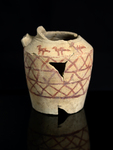
Stratum III (ninth–tenth centuries CE). After the cave was abandoned for a while, it was modified for residential use. The façade and the staircase were rebuilt, and the crushing basin was removed. A wall was built above the pressing installation, and it probably served as a partition. One of the pressing installation’s piers was moved and laid down on the mosaic floor of the working surface, and soil was poured over the surface. On top of the foundation of the pressing installation, a bodeda was carved into the bedrock (see Fig. 5, left); the bodeda was used as a household installation for producing olive oil. Between the pressing installation and the toppled pier, a bedding of an unidentified installation, made of small fieldstones and mortar (1.0 × 1.2 m), was uncovered. The stratum was dated based on pottery, which includes buff-fabric vessels typical of the Abbasid period. A unique find from this stratum is a buff-fabric jug decorated with images of animals (Fig. 6; Shmueli et al. 2025). At the end of this time span, the cave was abandoned.
Stratum II (thirteenth–fourteenth centuries CE). The cave was reoccupied and modified for residential use. Built walls formed the façade, the staircase was renovated, and the entranceway was constructed again. Walls were built inside the cave, dividing it into several spaces (Shmueli and Amit 2014 and see therein for further details about this stratum). The stratum was dated based on the large number of handmade geometrically painted (HMGP) vessels, painted red and black, which were in use during the Mamluk period.
Stratum I (nineteenth–first half twentieth centuries CE). The entrances to the cave were blocked with stones, and the courtyard was used as a livestock enclosure. The stratum was dated based on the pottery assemblage that includes Black Gaza Wares, which were used at the end of the Ottoman period and beginning of the British Mandate.
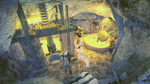
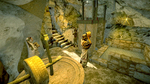
During the excavation, the oil press was fully uncovered. It was built in the Umayyad period, and it included an olive crushing installation, a pressing installation and a work surface (for reconstruction of the oil press, see Figs. 7, 8). The crushing stone turned on the circular crushing basin, probably using animal labor. The pressing installation comprised two stone piers, a wooden press, which was used to press baskets of olives, and a collecting vat for the oil. The working surface was built at a slightly lower level than the base of the pressing installation to facilitate convenience and efficiency. The oil press was seemingly built meticulously to produce large quantities of high-quality olive oil and extract the maximum amount of oil.
The oil press went out of use during the Abbasid period, and the cave was adapted for residential use. After this period, the site was abandoned. During the Mamluk period, the site was reoccupied, and the cave was adapted for residential use again. At the end of this period, the cave was abandoned and later reoccupied only at the end of the Ottoman period–beginning of the British Mandate.
References
Amit D. 2003. The Synagogues of Horbat Ma‘on and Horbat ‘Anim and the Jewish Settlement in the Southern Hills. Ph.D. dissertation, The Hebrew University. Jerusalem (Hebrew; English summary, pp. vi–xxxvii).
Shmueli O. and Amit D. 2014. Horbat ‘Anim. HA–ESI 126. https://doi.org/10.69704/jhaesi.116.2004.10618
Shmueli O., Eisenberg-Degen D., Cytryn K. and Cohen-Weinberger A. 2025. An Early Islamic Period Ceramic Jug Decorated with Animal Figures from Horbat ‘Anim. In D. Eisenberg-Degen, Y. Tchekhanovets and A. Rasiuk eds. Archaeological Excavation and Research Studies in Southern Israel, Collected Paper 7: 20th Annual Southern Conference. Jerusalem. Pp. 49–61 (Hebrew).
Keywords
southern Hebron Hills, Yatir Forest, olive press, olive oil production, olive crusher, olive press installation, industrial mosaic, Umayyad period, Abbasid period, Mamluk period, Ottoman period, cave
Publication Date
07/10/2026
Report Type
Preliminary Report