
Ḥorbat Sussita (Hippos) – 2022, 2023 (G-3/2022, G-10/2023)
Permit/License Number
G-3/2022, G-10/2023
Excavation Report
In 2022 and 2023, excavations were conducted at Horbat Sussita (Hippos; License Nos. G-3/2022, G-10/2023; map ref. 261829–2421/742664–895) by the Hippos Excavation Project of the Zinman Institute of Archaeology, University of Haifa. The excavation, located within Sussita National Park and conducted with permits from the Israel Nature and Parks Authority (NPA; A001-22, A006-23), was directed by A. Kowalewska and M. Eisenberg, with the assistance of R. Tomaszewski, J. Rentz and A. Bernard (field supervision), Y. Qedem (field conservation), Y. Isakova (finds processing), N. Koskanen (metal finds conservation), A. Iermolin (small finds conservation and artefact illustration), D. Syon (numismatics), M. Osband (ceramics), G. Staab (Greek epigraphy) and Y. Yehezkel, the Sussita National Park manager, and his team (logistic assistance during the 2023 season). The workforce included participants from all over the world, among them students from the University of Haifa (2022) and the Center for Field Sciences in Los Angeles, USA (2023).
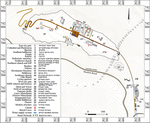
The excavations at Horbat Sussita (Hippos; also known as Antiochia Hippos of the Decapolis), located 2 km east of the Sea of Galilee, have been carried out since 2000 (Kowalewska and Eisenberg 2023; Hippos Excavations Project website). In 2022 and 2023, work was conducted in four excavation areas (Fig. 1): Burial Cave B at the Saddle Necropolis (NSD; Fig. 1:B); the frontal gate above the ditch in the saddle (HDSL/PRT; Fig. 1:18); the cardo south of the decumanus maximus (DMW; Fig. 1:12I); and the Southwest Church (SWC; Fig. 1:14).
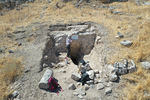
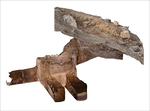
Burial Cave B (NSD). Burial Cave B is located on the eastern slope of the saddle, some 35 m north of the ditch (Fig. 1:B). It was discovered in April 2022, when a partly exposed inscription was noticed engraved in bedrock (Fig. 2). It turned out that the inscription was located above the entrance to the burial cave. The small Greek letters, c. 2 cm high, were arranged in seven or eight lines. Many of the letters are unclear or missing due to damage to the surface, so that reading of the inscription is not a straightforward matter, and the text has not yet been deciphered.
The cave was fully exposed (Fig. 3), revealing that its three burial niches (kokhim) had been robbed in antiquity; the entrance was found blocked with large stones, among them one of the drums from the basalt pressure pipe of the city’s water supply. Only Roman-period pottery and glass shards, dating mainly to the second–third centuries and no later than the fourth century CE, were retrieved from the area, indicating that the burial cave was contemporary with the other burials in the Saddle Necropolis.
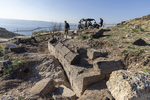
Frontal Gate above the Saddle Ditch (HDSL/PRT). This area consists of a small hill above and to the north of the defensive ditch cut in the middle of Mt. Sussita’s topographic feature known as the saddle. Before the excavation, it was assumed to be a proteichisma—part of the city’s Hellenistic–Early Roman-period outworks that were later rebuilt into a frontal gate during the Roman period. Limited excavation at the southern part of the area, just above the ditch, exposed part of the southern wall or walls of the gate, mainly part of what seems to be the gate’s eastern tower (Fig. 4). All the in situ ashlars and moulded decorations are of fine-hewed basalt that highly resembles the construction of the propylaeum (monumental gate; Fig. 1:23), built only 30 m to the west and next to the western part of the ditch (Eisenberg 2019). The propylaeum was built in the early second century CE and collapsed during the 363 CE earthquake; this is the tentative dating for the frontal gate as well, since no datable material was found in connection with it.
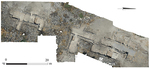
Cardo South of Decumanus Maximus West (DMW). The excavation around a southern cardo, south of the odeion, is a continuation of the 2019 season (Kowalewska and Eisenberg 2021). During 2022 and 2023, the continued course of the cardo was exposed (Fig. 5), and some of the structures to its sides were partly investigated.
All the excavation probes showed a pattern of complete rebuilding of this area toward the end of the fourth century CE and its use through the Byzantine period without a continuation into the Early Islamic period, at which time almost all the walls were built anew and all previous architecture (Hellenistic- and Roman-period) was completely removed by razing down the buildings. Despite all the changes, the orthogonal pattern of the streets was kept, and at least some of the streets, including the cardo, followed the Roman-period grid. The continuation of excavations in future seasons should provide evidence to better pinpoint this major rebuilding in time and assess if it can be correlated to the destruction caused by the 363 CE earthquake.
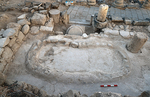
One of the main points of interest investigated involved the insulae directly at the edge of the cardo and the decumanus maximus. The eastern part of this area produced especially interesting finds, including two distinct Byzantine-period construction phases. The upper phase, tentatively dated to the sixth–seventh century CE, had a roofed room with two construction phases of plastered installations. The well-preserved later installation included a well-plastered floor with a shallow basin (length 3 m, width 1 m, depth 0.15 m) in the middle, which was coated with the same plaster as the floor (Fig. 6) and had no point of drainage. No parallel to this installation has been identified yet. The lower phase, c. 0.5 m below the room with the plastered installations and tentatively dated to the fifth century CE, was a well-executed colorful mosaic floor, which depicted a medallion with a short Greek inscription (“Greetings to the Elders”) accompanied by a cross and the letters alpha and omega (Staab, Kowalewska and Eisenberg 2025), surrounded by large birds (Egyptian geese), trees and panels with partridges eating grapes from vines. Only a fragment of this mosaic has been exposed for now.
The excavation probes in this area also revealed the presence of Chalcolithic-period pottery sherds in the lowest levels, right above bedrock. These sherds add to the assemblage of the Chalcolithic-period pottery from Hippos, which has recently been published (Hruby et al. 2024). This Early–Middle Chalcolithic presence was apparently the only phase of settlement at Mt. Sussita before the Hellenistic period.
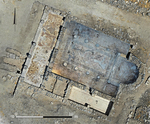
The Southwest Church (SWC). The excavation at the Southwest Church is a continuation of the 2019 season (Kowalewska and Eisenberg 2021). During 2022 and 2023, the Southwest Church was almost fully exposed (Fig. 7), including the main hall of the church, the northeastern room (now backfilled), two rooms of the southern wing, the atrium’s eastern portico and a cistern beneath the atrium. A total of seven inscriptions were exposed on the mosaic floor of the church (Fig. 7: Nos. 1–7; Staab, Kowalewska and Eisenberg 2022; Staab and Eisenberg 2024). The floors of the southern wing and the atrium’s eastern portico were fully exposed and conserved in 2022 and 2023, followed by their covering with sand, a shade tarp and soil for protection, as was previously done with the mosaic in the main hall. Extensive conservation was also applied to the plaster covering the walls and columns inside the church, although no paintings were discovered, and all proved to have been plain white.
The southern wing of the church was composed of two rooms. The western room had a plaster floor and was entered only from the atrium. The eastern room, entered from inside the church, was probably a chapel; it had a colorful mosaic floor with an inscription of donation set in a medallion, designed to face east, where it was partly divided to two spaces by columns placed next to the walls. While this may have been the location of the altar, no liturgical furniture has been found inside the room, and no lacunae were present in the mosaic to evidence the placement of an altar.
A part of the church near the three portals of the basilica and the entrance to the southwestern room was also covered by a mosaic floor, enclosed by a colonnade on its western edge. We re-erected several bases and column drums that were found with the church’s collapsed material, and added them to the two in situ bases on the stylobate of the atrium’s eastern portico, as part of their protection and for enhancement of the park’s visitor experience. The mosaic inside the portico is composed of a medallion with an inscription of donation, located on the axis of the main portal, and squares filled with various motifs of plants, birds and geometric symbols. On the north and south, this space was enclosed by walls. To the west of the colonnade was a plastered surface of the open-air part of the atrium. Since no other portico has been identified, the limits of the atrium are unknown.
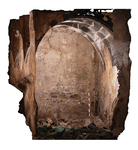
In the southeastern part of the atrium, a small plastered collection basin was exposed. It emptied through a ceramic pipe, c. 10 cm above its floor in the basin’s northern wall, which connected it to a rectangular cistern. The cistern (length 4.5 m, width 3 m, depth c. 5 m) was particularly well-preserved—with large parts remaining of the white hydraulic plaster covering the walls—and well-constructed, roofed by basalt beams resting on meticulously cut basalt ashlar arches (Fig. 8). Pottery sherds collected from the cement that covered the basalt beams of the cistern’s roof were all of the Early Roman period (not later than the first century CE). Many large stones were found at the bottom of the cistern, fully covering its floor, and its plaster floor was exposed only in a small probe. A second water inlet into the cistern was visible in the northwestern corner of the roof. The cistern is one of a few fully preserved Roman-period arched cisterns, among the earliest known. Most probably, it originally served a Roman-period neighborhood, which had been almost fully obliterated by the Byzantine-period neighborhood built later on. The cistern’s entrance was sealed with the original stones at the end of the excavations.
The 2022 and 2023 excavations at Hippos revealed a wealth of additional information about the Graeco-Roman city, especially about the little explored southwestern part of the site and the extent of the rebuilding at the end of the fourth century CE.
References
Eisenberg M. 2019. The Propylaeum of the Extra Muros Sanctuary at Hippos. In A. Eisenberg and A. Ovadiah eds. Cornucopia: Studies in Honor of Arthur Segal (Archaeologica 180). Rome. Pp. 95–121.
Eisenberg M., Staab G. and Kowalewska A. 2025. The Martyrion of Theodoros at Hippos above the Sea of Galilee. Byzantinische Zeitschrift 118/1:103–140. https://doi.org/10.1515/bz-2025-0005
Hruby K., Kowalewska A., Rosenberg D. and Eisenberg M. 2024. A Chalcolithic Presence East of the Sea of Galilee: The Earliest Finds on Mt. Sussita. PEQ 156:295–321. https://doi.org/10.1080/00310328.2023.2277625
Kowalewska A. and Eisenberg M. 2021. Horbat Sussita (Hippos) – 2018, 2019. HA-ESI 133. https://doi.org/10.69704/jhaesi.116.2004.25930
Kowalewska A. and Eisenberg M. 2023. Horbat Sussita (Hippos) – 2021. HA-ESI 135. https://doi.org/10.69704/jhaesi.116.2004.26294
Staab G. and Eisenberg M. 2024. Two New Mosaic Inscriptions from the Martyrion of Theodoros at Hippos above the Sea of Galilee and a Summary of All Seven Inscriptions. ZPE 230:127–135.
Staab G., Kowalewska A. and Eisenberg M. 2022. Two Additional Inscriptions from the Martyrion of Theodoros in Hippos of the Decapolis. ZPE 222:131–137.
Staab G., Kowalewska A. and Eisenberg M. 2025. An Inscription to the Elders: A Possible Identification of a Home for the Elderly (ΓΗΡΟΚΟΜΕΙΟΝ) in Hippos Above the Sea of Galilee. ZPE 234:212–216.
Keywords
Sussita, Hippos, Graeco-Roman city
Publication Date
25/05/2026
Report Type
Preliminary Report