
Karmiyya (A-9352)
Permit/License Number
A-9352
Excavation Report
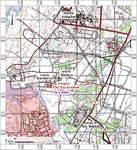
In July 2022, a salvage excavation was conducted at Kibbutz Karmiyya (Permit No. A-9352; map ref. 156665–732/612462–511; Fig. 1), following construction works. The excavation, on behalf of the Israel Antiquities Authority was directed by I. Peretz (field photography), with the assistance of Y. Alamor (administration), A. Levi (photography and logistics), I. Azoulay (plans and map), E. Aladjem (photogrammetry), A. Fraiberg (digital recording), A. Golani (scientific guidance), S. Talis (Iron Age pottery and guidance), T. Winter (glass), R. Lewis Bloom (glass restoration), I. Lidsky-Reznikov (glass drawing), Y. Nagar (physical anthropology), N. Wieler (stone object and geographic consultancy) and L. Peretz.
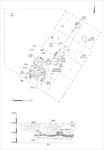
Ancient remains extending over an area of about 20 × 35 m, were found at Kibbutz Karmiyya, on the slope of a kurkar ridge, about a kilometer north of Naḥal Shiqma. Two excavation squares (Figs. 2, 3) were opened in the eastern part of the area, with better preservation of the remains. The finds included Iron Age IIC kiln debris, a building and a tomb dated to the Byzantine period on the basis of the pottery and glass finds, as well as a few pottery fragments dated to the Hellenistic and Roman periods.
A previous survey of the area, the Ziqim Survey Map, documented scattered building stones, pieces of plaster, tesserae and finds from the Hellenistic, Roman and Early Islamic periods, where the tomb of Sheikh Sa‘id had once stood at the site of the current excavation (Berman, Stark and Barda 2004: Site 122). Additional surveys documented pottery and flint items from the Iron Age II and the Persian period at this location (Permits Nos. G-146/1998, G-486/2014, G-558/2015). Previous excavations at the kibbutz and surrounding area uncovered tombs and a winepress from the Byzantine period, as well as finds from the Hellenistic and Early Roman periods (Gophna and Meron 1969; Porat and Meron 1977; Bischoff-Bruintjes 2022 [Fig. 1: A-8809], and see therein for reference to further excavations).
Iron Age IIC
In the northwestern part of the excavation, a layer of ash, a cluster of fired and crumbling bricks, slag and numerous fragments of pottery dating to the end of the seventh century CE were found in an area of c. 7 × 10 m (L3). These are all the remains of pottery kilns, indicating that a pottery workshop was active at the site. A similar concentration of kiln debris with numerous pottery fragments dating to the end of the seventh century BCE (L6; not on plan) was observed in the southern profile of the excavation and next to it. This kiln debris sat at least one meter higher in elevation than L3 and extended down to the kurkar bedrock. Southeast of the kiln debris in L3, a fill of sand mixed with brown clay (L5, L18–L20, L22, L23) and a layer of yellowish earth (L21) were uncovered, and within them a large quantity of pottery fragments, predominantly from the seventh century CE, and a few dating to the Byzantine period, the latter retrieved from Loci L5, 18 and 19.
The Byzantine Period
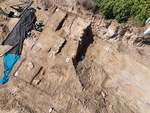
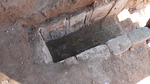
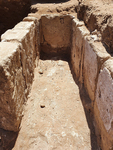
In this phase, a cist tomb (L17; 0.55 × 1.55 m; Figs. 4–6) was built atop the aforementioned fills, and above it a building. The tomb’s orientation parallelled that of one of the building’s walls, and they therefore seem to have been interrelated. The tomb, which was excavated into the fills mentioned above, was built of well-hewn chalk slabs placed on their narrow edge, with small stones between them. A white crumbly material was found on the walls and floor of the tomb, perhaps remnants of plaster. Poorly preserved human bones were found in the tomb, among them bones from the lower body of an adult individual whose sex is unknown and who was over 15 years old (see Fig. 5). Just north of the tomb, a fragment of a Byzantine-period glass bottle (see below) that originated in an intrusion related to the construction of the tomb and the building was found in the Iron Age sand Accumulation 19. A fill (L15, L16) of sand, brown clay, bonding materials, a few stones and pottery fragments dated predominantly to the Iron Age, was placed over the tomb, and atop it one of the building’s floors (L7, see below) was laid.
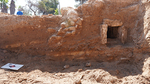
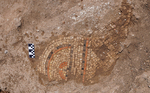
The building’s walls (W10, W12, W13, W24; another wall uncovered in the southern excavation profile is not marked on the plan), seem to delineate two rooms (1, 2), and perhaps a third (3) to the east. These walls were constructed of fieldstones and semi-hewn kurkar stones, bonded with light gray mortar. In the southernmost Room 1, a small patch of mosaic floor (L7; 0.4 × 0.5 m; Fig. 7) with mortar bedding, laid over Fills 15 and 16 and above the location of the tomb, was found. The tesserae are white, red and blue (each c. 1 × 1 cm), and the mosaic’s design is half a circle, probably delineated originally by a frame. The floor did not survive near the walls but seems to have abutted them. A single fragment of an ARS bowl dated to the first half of the fifth century CE (below, Fig. 12:3) was found in Fill 15 below mosaic Floor 7, which dates the building’s construction. A mixed fill of sand and stones containing pottery from the Iron Age and the Byzantine period (L11), was found in Room 2. A small patch of a stone floor (L25) was uncovered in Room 3, as well as mortar (L26), which may have served as its bedding. A well-crafted hewn stone was found between W10 and W24, possibly a threshold, that represents a doorway between Rooms 2 and 3. Tile fragments found throughout the building (see below) indicated a tiled roof.
The aforementioned fragments of an ARS bowl and a glass bottle date the construction of the building to the first half of the fifth century CE. Additional Byzantine-period pottery fragments were found in association with the building, in disturbed strata also containing pottery from the Iron Age IIC. The latest pottery and glass vessels in the excavation date the end of the building’s use to the end of the Byzantine–beginning of the Early Islamic period (mid-sixth to end of seventh century CE).
The Pottery Assemblage
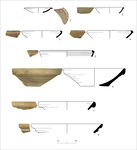
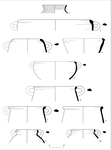
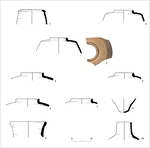
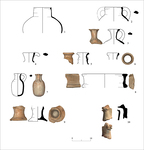
The Iron Age IIC (seventh century BCE). Most of the pottery in the excavation was dated to this period. Most of the finds illustrated in the figures were found in the accumulated sand and clay on which the Byzantine-period building was built, while the remaining few were found in the kiln debris. The vessel types are known from the coastal sites of Philistia, especially from Ashqelon. Finds include bowls (Fig. 8:1–5), mortars (Fig. 8:6–8) of a type also known from Persian-period sites, kraters (Fig. 9:1–8), cooking pots (Fig. 9:9, 10), a holemouth jar (Fig. 10:1), jars (Fig. 10:2–8), jars/jugs (Fig. 10:9, 10), jugs (Fig. 11:1–6), a juglet (Fig. 11:7), a stand (Fig. 11:8) and a base of a chalice or a goblet (Fig. 11:9). Also, a figurine of a horse or a rooster was found (Fig. 11:10), similar to figurines that had previously been found at Tel Ashqelon that indicate the influence of Phoenician culture in the region during the seventh century BCE (Cohen 2011:443).
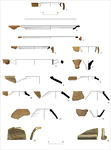
The Hellenistic, Roman and Byzantine Periods. Two pottery fragments of the Hellenistic and Roman periods were found that were not associated with an architectural context: a fragment of a Hellenistic-period krater (Fig. 12:1; see Berlin 2015:636), of a type also known from the Iron Age; and the base of a bowl from the Roman-period ETS family (not illustrated).
The Byzantine-period pottery includes: two imported bowls of ARS Form 67 (Fig. 12:2, 3); a fragment of LRC bowl Form 3 (Fig. 12:4); an FBW beaker type (Fig. 12:5); a casserole (Fig. 12:6); an amphora base, probably from southern Spain, which is dated to the end of the third/beginning of the fourth–first half of fifth century CE (Fig. 12:7); Gaza or holemouth jar (Fig. 12:8); Gaza/Ashqelon jars (Fig. 12:9–14), some of them (Nos. 9–11) of a type familiar from the fourth–first half of the fifth century CE; and rooftile fragments (Fig. 12:15, 16).
The Glass Finds
Tamar Winter
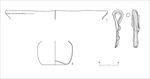
The glass finds comprise 18 fragments that represent six vessels typical of the Byzantine period in Syria-Palestina, among them a lamp (Fig. 13:1) and a bottle (Fig. 13:2), as well as fragments (from L1 and L2; not illustrated) of a rim of a beaker or a lamp, a lamp handle and two bases. Several modern-day fragments were also recorded (L2; not illustrated).
The lamp fragments (Fig. 13:1) were found next to W12, and they include an uneven cut rim and a handle whose lower part is shaped as a wavy ribbon. The lamp, which is characteristic of the Byzantine period, belongs to a type with a cut rim, a globular body, a rounded bottom and three loop handles attached to the body on both ends. A metal wire or a rope inserted through the handles enabled the suspension of the lamp (Winter 2019:58–62, Types LGLsh, LGLte and LGLdh). Similar lamps were uncovered throughout Israel, and examples from the western Negev were documented at Niẓẓana (Harden 1962:76–77, 85–86, Pl. XXVIII:56), Ashqelon (Katsnelson and Jackson-Tal 2004:106–107, Fig. 3:2), Rehovot-in-the-Negev (Patrich 1988:140–141, Pl. XIV:38) and Giv‘ot Bar (N.S. Paran; Permit Nos. A-4479, A5960).
The bottle (Fig. 13:2) has a squat globular body and a concave bottom, and it is typical of Byzantine-period bottles with a long neck (Winter 2012:38–42, Types BTrr, BTir). The bottle was found next to the northern side of a cist tomb, in an earth accumulation (L19) which also yielded pottery fragments dated mostly to the Iron Age (see above). Similar bottles were unearthed throughout Israel, and examples from the northern Negev were found at Ashqelon and Ḥorbat Karkur ‘Illit (Katsnelson 1999:72*–74*, Fig. 3:8–12; 2004:277–278, Fig. 62:1–6).
The excavation uncovered workshop debris dated to the Iron Age IIC (seventh century BCE). They could possibly be associated with a pottery kiln previously discovered in nearby Khirbat Bakkita, and together they may indicate a local specialization. During this period, the site was located within the territory of Philistia and was part of the hinterland of Ashqelon in Iron Age IIB–C (Shavit 2008). The next significant settlement phase at this location was during the Byzantine period (fifth–sixth centuries CE), when the exposed building and the cist tomb were built. The building’s construction was dated to the fifth century CE according to the pottery and glass finds. The latest pottery fragments and the glass lamp that were found indicate that the building remained in use until the late Byzantine period–beginning of the Islamic period (mid-sixth–end of seventh century CE). The size of the building, the mosaic floor, the tiled roof and the glass oil lamp indicate that it may have served as a church, a chapel or a mausoleum. The mosaic floor overlying the tomb may have been laid in connection with the burial and could testify to the high status of the interred. The cist tomb joins a growing number of tombs previously found at the site (Gophna and Meron 1969; Porat and Meron 1977), indicating that the area was used for burial during the Byzantine period. It is possible that the burial tradition was preserved at the site over the generations until 1948, as attested by the tomb of Sheikh Sa‘id discovered at the site (Berman, Stark and Barda 2004: Site 122). The exposed cist tomb may have been part of the cemetery of the town of Saraphia, which is mentioned in Roman- and Byzantine-period sources, and was identified in nearby Khirbat esh-Sharaf and Hirbiya as Diocletianopolis (Fuks 2001:76–77; Berman, Stark and Barda 2004: Sites 87 and 123, respectively).
References
Bachi G. 1971. Area D: The Finds. In M. Dothan. Ashdod II–III: The Second and Third Seasons of Excavations 1963, 1965; Soundings in 1967. Text (‘Atiqot [ES] 9–10). Jerusalem. Pp. 94–113.
Berlin A.M. 2015. Hellenistic Period. In S. Gitin ed. The Ancient Pottery of Israel and Its Neighbors from the Iron Age through the Hellenistic Period 2. Jerusalem. Pp. 629–671.
Berman A., Stark H. and Barda L. 2004. Map of Ziqim (91) (Archaeological Survey of Israel). Jerusalem.
Bischoff-Bruintjes E. 2022. Karmiyya, Hirbiya. HA–ESI 134. https://doi.org/10.69704/jhaesi.116.2004.26187
Cohen S.L. 2011. Terracotta Figurines. In L.E. Stager, D.M. Master and J.D. Schloen eds. Ashkelon 3: The Seventh Century B.C. Winona Lake. Pp. 441–472.
Dothan M. 1971. Ashdod II–III: The Second and Third Seasons of Excavations, 1963, 1965; Soundings in 1967 (‘Atiqot [ES] 9–10). Jerusalem.
Fuks G. 2001. A City of Many Seas: Ashkelon during the Hellenistic and Roman Periods. Jerusalem (Hebrew).
Gilboa A. 2015. Iron Age IIC: Northern Coast, Carmel Coast, Galilee, and Jezreel Valley. In S. Gitin ed. The Ancient Pottery of Israel and Its Neighbors from the Iron Age through the Hellenistic Period 1. Jerusalem. Pp. 301–326.
Gitin S. 2015. Iron Age IIC: Philistia. In S. Gitin ed. The Ancient Pottery of Israel and Its Neighbors from the Iron Age through the Hellenistic Period 1. Jerusalem. Pp. 383–418.
Gophna R. and Meron D. 1969. Burial Cave at Karmiyya. HA 31–32:25 (Hebrew).
Harden D.B. 1962. Glass. In H.D. Colt ed. Excavations at Nessana (Auja Hafir, Palestine) 1. London. Pp. 76–91.
Hayes J.W. 1972. Late Roman Pottery. London.
Katsnelson N. 1999. Glass Vessels from the Painted Tomb at Migdal Ashqelon. ‘Atiqot 37:67*−82*.
Katsnelson N. 2004. Glass Objects. In P. Figueras ed. Horvat Karkur ‘Illit: A Byzantine Cemetery Church in the Northern Negev (Final Report of the Excavations 1989−1995) (Beer-Sheva XVI). Be’er Sheva‘. Pp. 265−291.
Katsnelson N. and Jackson-Tal R.E. 2004. The Glass Vessels from Ashqelon, Semadar Hotel. ‘Atiqot 48:99−109. https://doi.org/10.70967/2948-040X.2215
Keay S.J. 1984. Late Roman Amphorae in the Western Mediterranean: A Typology and Economic Study; The Catalan Evidence (BAR Int. S. 196) (2 vols.). Oxford. https://doi.org/10.30861/9780860542506
Magness J. 1993. Jerusalem Ceramic Chronology: Circa 200–800 CE (JSOT/ASOR Monograph Series 9). Sheffield.
Majcherek G. 1995. Gazan Amphorae: Typology Reconsidered. In H. Meyza and J. Młynarczyk eds. Hellenistic and Roman Pottery in the Eastern Mediterranean—Advances in Scientific Studies (Acts of the II Nieborów Pottery Workshop, Nieborów, 18–20 December 1993). Warsaw. Pp. 163–178.
Mazar A. and Panitz-Cohen N. 2001. Timnah (Tel Batash) II: The Finds from the First Millennium BCE (Qedem 42) (2 vols.). Jerusalem.
Patrich J. 1988. The Glass Vessels. In Y. Tsafrir. Excavations at Rehovot-in-the-Negev I: The Northern Church (Qedem 25). Jerusalem. Pp. 134−141.
Porat Y. and Meron D. 1977. Karmiyya. HA 61–62:36 (Hebrew).
Shavit A. 2008. Settlement Patterns of Philistine City-States. In A. Fantalkin and A. Yasur-Landau eds. Bene Israel: Studies in the Archaeology of Israel and the Levant during the Bronze and Iron Ages in Honour of Israel Finkelstein (Culture and History of the Ancient Near East 31). Leiden–Boston Pp. 135–164. https://doi.org/10.1163/ej.9789004152823.i-308.79
Stager L.E., Master D.M. and Schloen D.J. 2011. Local Pottery. In L.E. Stager, D.M. Master and J.D. Schloen eds. Ashkelon 3: The Seventh Century B.C. Winona Lake, Ind. Pp. 71–96.
Stern E. 2015. Persian Period. In S. Gitin ed. The Ancient Pottery of Israel and Its Neighbors from the Iron Age through the Hellenistic Period 2. Jerusalem. Pp. 565–617.
Winter T. 2019. Lucid Transformations: The Byzantine–Islamic Transition as Reflected in Glass Assemblages from Jerusalem and Its Environs, 450–800 CE (BAR Int. S. 2946). Oxford.
Keywords
pottery kiln, Iron Age II, Byzantine period, cist tomb, structure, mosaic floor, roof tiles
Publication Date
25/05/2026
Report Type
Final Report