
‘Ein Umm el-Ḥannun (A-9340)
Permit/License Number
A-9340
Excavation Report
During July–August 2022, a trial excavation was conducted west of ‘Ein Umm el-Ḥannun and south of Khan el-Lajjun (Permit No. A-9340; map ref. 217620/719054) prior to expanding Megiddo Prison. The excavation, on behalf of the Israel Antiquities Authority and financed by the Israel Prison Service, was directed by N. Benenstein, with the assistance of B. Tzin, P.R. Zajac and A. Najar (area supervision), Y. Zilpa (administration), A. Wiegmann (photography and photogrammetry), A. Elghani Ibrahim (field photography), A. Kleiner (surveying and drafting), E. Dalali-Amos (plan) and B. Hana, R. Be’eri and Y. Tepper (scientific guidance).
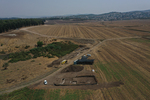
The excavation was conducted in an open area south of Naḥal Qini and Tel Megiddo (Fig. 1). A prior survey in the area of Legio–Megiddo identified near the spring pottery from the Early Bronze Age, and north of the excavation area, flour mills, water channels, ancient roads, architectural remains, agricultural installations, stelae and tombs were also discovered as well as the garrison of the Sixth Roman Legion (Ferrata) and the village of Kefar ‘Otnay (Tepper 2002; 2003). A previous excavation north of the site near Road 65 discovered field walls, a few flint tools and pottery from the Roman and Byzantine periods (Atrash 2015).
Probes undertaken prior to the excavation identified habitation levels, pottery and walls. Consequently, five excavation areas were opened (A–E; 28 squares), but archaeological remains were uncovered only in Areas A and B. Two strata were identified in the excavation; Stratum 2 contained Early Bronze Age IA architectural remains, and Stratum 1 contained an aqueduct, a local road and tombs dated to the Roman period.
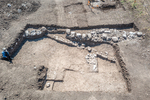
Stratum 2—Early Bronze Age IA (3700–3300 BCE). Remains of buildings constructed of fieldstones were found (Fig. 2). The building floors were laid on top of each other in two–four construction phases. Habitation levels of packed brown earth and circular installations, used probably for storage, were also found. Among the finds were pottery sherds, flint items and grinding tools.
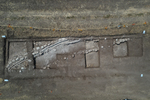
Stratum 1—Roman Period (second–third centuries CE). An aqueduct built of hewn and plastered stones was exposed; next to it on the east, there was a segment of a local road (path) built of fieldstones (Fig. 3). Pottery sherds and coins were recovered near the aqueduct and in the excavation of the road. A few built tombs were also uncovered, and one, which was sealed with hewn stone slabs, was excavated. A heap of collapsed ashlars was exposed above the tomb; these may be from a mausoleum that was not preserved.
The architectural remains from the Early Bronze Age IA are probably part of a rural settlement, which is one of many found near Tel Megiddo and dated to this timespan (Benenstein et al. forthcoming and see references therein). The Roman-period aqueduct probably transported water to agricultural plots or nearby buildings. If future studies confirm that the aqueduct leads to the Roman legion garrison north of Naḥal Qini, its discovery will contribute to the study of water sources that sustained the garrison. The tombs that were uncovered during the excavation indicate that there was a cemetery associated with the water source and the local road (see Tepper 2025; 2026).
References
Atrash W. 2015. Khan el-Lajjun. HA–ESI 127. https://doi.org/10.69704/jhaesi.116.2004.14725
Benenstein N., Paz Y., Yaroschevich A., Cohen-Weinberger A., Adams M. and Tepper Y. Forthcoming. ‘Ein Umm el-Ḥannun: An Early Bronze I site near Tel Megiddo. Antiguo Oriente.
Tepper Y. 2002. Lajjun-Legio in Israel: Results of a Survey in and around the Military Camp Area. In P. Freeman, J. Bennett, Z.T. Fiema and B. Hoffmann eds. Limes XVIII (Proceedings of the XVIIIth International Congress of Roman Frontier Studies Held in Amman, Jordan, September 2000) I (BAR Int. S. 1084). Oxford. Pp. 231–242.
Tepper Y. 2003. Survey of the Legio Region. HA-ESI 115:29*–31*.
Tepper Y. 2025. A Spring Tunnel, Aqueducts and Water-Powered Flour Mills along Naḥal Qeni: A History of Water Exploitation. ‘Atiqot 119. https://doi.org/10.70967/2948-040X.2366
Tepper Y. 2026. The Roman Legionary Base at Legio as Capita Viarum and its Rule in the Development of the Roman Imperial Road Network in Northern Israel. ‘Atiqot 120. https://doi.org/10.70967/2948-040X.2410
Keywords
Khan al-Lajjun, Tel Megiddo, Roman period, Early Bronze Age, Aqueduct, Built tombs, Roman legion camp, Rural settlement, Nahal Qini
Publication Date
22/10/2026
Report Type
Preliminary Report