
Khirbat et-Tineh (A-8260)
Permit/License Number
A-8260
Excavation Report
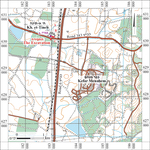
During April–May 2018, a trial excavation was conducted at Khirbat et-Tineh, northwest of Kibbutz Kefar Menaḥem (Permit No. A-8260; map ref. 182873–3101/628193–235; Fig. 1), following the widening of Road 383 and its connection to the nearby train station, Qiryat Mal’akhi–Yoav. The excavation, on behalf of the Israel Antiquities Authority and funded by Israel Railways, was directed by O. Shmueli, with the assistance of Y. Vassal (area supervision), Y. Alamor (administration), E. Aladjem, M. Kahan and I. Azoulay (surveying, drafting and plans), D. Dagan (field photography and scientific guidance), A. Shapiro (petrography), Y. Nagar (physical anthropology), E. Stern (pottery), T. Gonen (pottery restoration), I. Lidsky-Reznikov (pottery drawing), Y. Gorin-Rosen and B. Ouahnouna (glass artifacts), A. Lester (glass weight), C. Hersch (glass drawing), D. Gazit (studio photography), L. Sandberg (numismatics; Appendix 1), I. Reznitsky and L. Kupershmidt (metal laboratory) A. Gyerman-Levanon (digital documentation laboratory) and Y. Asscher and I.D. Peters (analytical laboratory). Help was also rendered by P. Betzer, S. Ganor, V. Lifshitz and S. Talis from the Southern Region and workmen from Tigbur Company.
Khirbat et-Tineh extends over an artificial hill, which is delineated on all sides by railway tracks and roads. The archaeological remains seemingly extend beyond the roads and railway. A previous excavation on the hill uncovered settlement remains dated to the Byzantine and late Ottoman periods (Haddad 2020 [Fig. 1: A-7755] and see therein for the history of site-research).
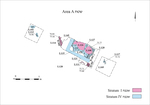
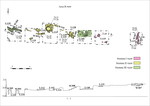
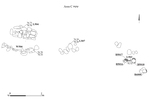
About 20 excavation squares were opened in the present excavation in three areas (A–C; Figs. 2–4) on both sides of Road 383. Excavations revealed the remains of a settlement with four strata dating to the Byzantine (Stratum IV), Early Islamic (Stratum III) and Mamluk (Stratum II) periods as well as the late Ottoman period–British Mandate (Stratum I). In the Mamluk-period Stratum II, a cemetery was also found (see Fig. 4). The finds include fragments of pottery and glass vessels, a glass weight, coins (Appendix 1) and a metal ring.
Stratum IV—The Byzantine Period
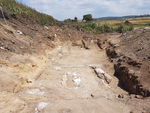
In Area A, excavations exposed a winepress with two treading floors: the primary (L116) and the secondary (L128). The winepress extends beyond the excavation boundaries and was damaged by pits that penetrated the treading floors during the Ottoman period (below); therefore, its plan was difficult to reconstruct. The primary treading floor (L116; 3.4 × 4.9 m), was paved with large white tesserae (4 tesserae/sq decimeter) laid on a foundation (min. thickness 0.35 m) of lime-based mortar mixed with small stones and shells. Along the edge of the treading floor, parts of a border (width 0.15 m) comprised of three rows of tesserae were found. A wall (W301; exposed length c. 3 m, width c. 1.15 m) bounded the treading floor on the east. The wall was constructed of small stones cast in calcareous mortar mixed with kiln debris. The western and southern boundary walls of the treading floor were not preserved, but they can be reconstructed based on their foundation trenches (L115, L145; width c. 2.1 m). The secondary treading floor (L128) is elevated c. 0.2 m above the primary treading floor. It was paved with small tesserae (8 tesserae/sq decimeter) that were laid on a bedding of small fieldstones. Segments of a courtyard (L113, L114, L117) were exposed to west and east of the winepress; it contained fragments of Gaza Ware wine jars dated to the sixth–seventh centuries CE. Other finds include glass vessel fragments from the fourth–fifth centuries CE and a coin dated to the sixth century CE (Appendix 1: Coin No. 2). These finds date Stratum IV to the Byzantine period. A glass bottle that was dated to the end of the Byzantine period (see below) indicates that this activity at the site continued until the end of the period.
Stratum III—The Early Islamic Period
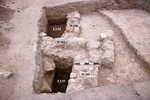
A building and the foundation of an industrial installation were uncovered in Area B. Three of the building’s walls were exposed (W304—exposed length c. 1.5 m, width 0.6 m; W305—exposed length c. 1.5 m, width 0.5 m, preserved height c. 1.2 m; W306—exposed length c. 2.2 m, width 0.4 m; Fig. 6); these delineated two rooms (L134, L135). The walls were built of two rows of fieldstones that were hewn on the outer face only and a core of small stones. The installation’s foundation (L140; Fig. 7) was built of small stones bonded with light gray mortar. In the northwestern corner of the square in which the foundation was found, a double-walled ceramic basin was partially uncovered.
The excavation uncovered fragments of pottery and glass vessels (below) from the eighth–tenth centuries CE as well as coins from the Umayyad and Fatimid periods (Appendix 1: Coins Nos. 4, 5). An additional Umayyad-period coin was found in Stratum IV (Appendix 1: Coin No. 3). The Fatimid-period coin indicates that activity at the site continued during this period.
Stratum II—The Mamluk Period
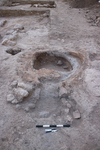
In Area B, a kiln, three walls and an installation were uncovered. The kiln (L142; c. 1.2 × 1.3 m; Fig. 8) was dug into the ground and lined with clay (side thickness 0.5 m; base thickness 0.1 m); the clay lining was baked during the firing process. A stokehole (width 0.4 m) built of limestone was exposed on the eastern side of the kiln. A layer of soot (0.1 m thick) accumulated on the kiln’s floor. Above it was collapsed orange baked clay, which was likely debris from the kiln’s wall. Pottery sherds from the Early Islamic and Mamluk periods and clay waste found inside the kiln suggest it was used to manufacture pottery. Outside the kiln (L121) was a layer of ash, which was probably debris from the kiln.
Two of the walls (W303, W310) were uncovered next to the kiln and may be associated with it. Wall 303 (preserved length c. 2 m) was built of undressed stones set on their narrow edges, while Wall 310 was built of medium-sized hewn stones, only three of which survived. The third wall (W308; length c. 2 m, width 1.8 m, preserved height 0.7 m) was built of large stones in secondary use, with small stones between them. North of W308, an ash layer (L138) mixed with many Mamluk-period pottery sherds was uncovered; this was probably part of a refuse pit for ceramic production debris.
The installation (L125) has a preserved wall made of fired clay (length 1.2 m, width 0.1 m) and a surface of tamped ash. It may have functioned as an oven.
Apart from the pottery sherds found in the kiln, excavations uncovered fragments of glass bracelets of types typical of the Mamluk and Ottoman periods (below). A coin dating to the twelfth century CE (Appendix 1: Coin No. 6) was also found on the surface next to the kiln; this suggests that the settlement in this stratum was established during the Crusader period.
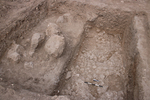
In Area C, a cemetery (Fig. 9), which was damaged by modern construction, was discovered. Two cist graves (L504, L507) and four bag-shaped jars (B5016–B5018, B6000) were preserved. Grave 504 (0.8 × 2.4 m) was built on an east–west axis from limestone slabs (average length 0.4 m, average thickness 0.2 m) that were placed on their narrow edges. A single covering slab was preserved in the eastern part of the grave. An adult male, over 30 years old, was discovered in the grave. The interred individual was laid supine, with his hands crossed on his chest and his head placed to the west and facing south. Grave 507 (0.7 × 1.8 m) survived partially; it was constructed of medium-sized limestone blocks, and no covering slab was preserved. Few human remains were found in the grave, suggesting it was looted or disturbed in antiquity. South of Grave 504, a row of stones (L506) was uncovered; this may be part of another grave, which was poorly preserved. Four bag-shaped jars were exposed east of the two graves (L503). They were buried in the ground upside-down and are fully preserved. Three of the jars were placed in a row, while the fourth was placed somewhat to their east.
The cemetery is at the southern end the site, marking the southern boundary of the settlement during this period. In his article about graves from the Mamluk and early Ottoman periods, Gorzalczany (2009) identified a particular type of cemetery in the central coastal plain that is characterized by cist graves covered with pottery vessels, mostly jars. He attributed this type of grave to a foreign population, likely Turkmans from eastern Asia who immigrated to territories of the Mamluk Empire (Gorzalczany 2009:234–236). The cemetery in Area C likely belongs to this type.
Stratum I—The Late Ottoman Period and the British Mandate
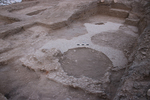
In Area A, a courtyard containing two circular pits (L108—diam. c. 1.8 m; L126—diam. c. 1.1 m; see Fig. 5) dug into the mosaic floor of the Byzantine-period winepress was exposed. Inside the pits, there was ash, suggesting they were used for cooking. Next to the pits, a circular clay oven (L111; diam. 1.1 m) was found. Two walls (W300, W302) were also attributed to this stratum. Wall 300 (length 2.6 m; width 0.5 m) was built of medium-sized fieldstones bonded with clay mortar mixed with small stones; only a single course was preserved. Wall 302 (length 1 m, width 0.8 m) was a clay-cast construction.
In Area B, only meager architectural remains were uncovered; these were damaged by modern construction. One wall (W307; exposed length c. 2 m, width 0.75 m) was constructed of two rows of medium-sized stones placed on their narrow edges, with a core of small stones. Adjacent to W307, there was another narrower wall (W309; length c. 1.5 m, width 0.4 m) built of small stones. East of the walls was a layer of packed earth mixed with chips of calcareous material (L136), and abutting the walls to the west was a surface of packed ash (L137) that was perhaps a floor.
Next to W309 was a cache of Black Gaza Ware dated to the late Ottoman period and the British Mandate. This corresponds with earlier studies that indicate there was a settlement at the site in the nineteenth century CE (Haddad 2020). A coin dated to the seventeenth–eighteenth centuries CE was found on the surface (Appendix 1: Coin No. 7), suggesting when the occupation began.
The Pottery Assemblage
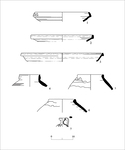
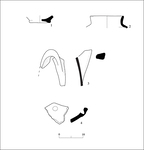
The Byzantine Period. The pottery is mostly dated between the fifth–seventh centuries CE. It includes Late Roman C Ware (LRC) bowls imported from Asia Minor (Fig. 10:1–3), which date to the first half of the sixth century. These are made of well-levigated and well-fired clay and feature a straight rim sloping slightly outwards. One bowl (Fig. 10:1) is decorated with a rouletted pattern. In addition, there is a bag-shaped jar (Fig. 10:4) with a short upright neck leaning slightly outward and a slightly out-turned rim, dating to the late Byzantine and early Umayyad periods. The assemblage also includes Gaza jars (Fig. 10:5, 6), characterized by a narrow, elongated and ribbed body and a slightly convex base (Form 4 according to Majcherek’s typology; Majcherek 1995:169, Pl. 3); these are dated to the sixth–seventh centuries CE. There is also a Fine Byzantine Ware (FBW) juglet (Fig. 10:7) dated to the fifth–seventh centuries CE; it is decorated with diagonal lines and has a handle that extends from the rim to the neck.
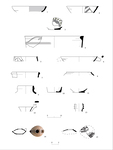
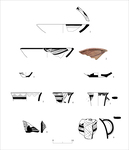
The Early Islamic Period. The pottery assemblage of this period is predominantly dated to the eighth–tenth centuries CE. It includes a simple bowl (Fig. 11:1) decorated internally with a brown-yellow glaze and externally with a gray slip as well as bowls of buff clay decorated with lead glaze and painted strokes (Fig. 11:2, 3), which are common during the second half of the eighth–tenth centuries CE and may imitate Mesopotamian imports. The assemblage also contains a type of krater (Fig. 11:4) typical of the late Byzantine and Early Islamic periods; it has horizontal wavy combed decoration and a thickened rim leaning outwards. A beaker made of well-levigated and well-fired clay and decorated with incisions (Fig. 11:5) dates to the Abbasid period; it is probably a variant of FBW beakers that were common during the late Byzantine and Umayyad periods. The cooking ware includes a casserole (Fig. 11:6) with a cut inverted rim and two horizontal handles dated to the sixth–tenth centuries CE; a cooking pan (Fig. 11:7) with an everted thumb indented rim and internal black glaze dated to the tenth–twelfth centuries CE; and a cooking pot (Fig. 11:8) with a carinated neck and an everted rim dated to the late fifth–early eighth centuries CE. There is also a bag-shaped jar (Fig. 11:9) with a straight neck and a slightly everted rim, which is common in the region during the late sixth–eighth centuries CE. There are a few jugs (Fig. 11:10–12) made of buff clay with flat bases; these are dated to the second half of the eighth–tenth centuries CE. One of the jugs (Fig. 11:12) has a braided strap handle with plastic decoration. There is also a mold-made flask (Fig. 11:13) of buff clay, characteristic of the Early Islamic period, and mold-made oil lamps (Fig. 11:14, 15) with almond-shaped bodies decorated with impressed vegetal and geometric motifs and dated to the second half of the eighth–eleventh centuries CE.
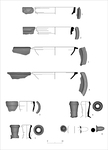
The Mamluk Period. The pottery includes wheel thrown and handmade pottery. The wheel thrown pottery (Fig. 12:1–15) is dated to the fourteenth–fifteenth centuries CE. It includes simple bowls (Fig. 12:1–3) with brown-orange fabric and thick walls, typical of the Byzantine–Mamluk periods; of these, Bowl 1 has a simple rim, while Bowls 2 and 3 have an everted rim. There is also a bowl with a disc base (Fig. 12:4), which is common during the twelfth–thirteenth centuries CE. Several monochrome glazed bowls (Fig. 12:5–7) dated from the late twelfth century–mid-thirteenth century CE were recovered; among them, Bowl 5 has a simple slightly everted rim and brown-orange glaze inside, Bowl 6 is decorated with thumb impressions and glazed internally with yellow glaze and Bowl 7 has an upright rim with green glaze internally. There is an imported Zeuxippus bowl (Fig. 12:8) made of well-levigated brown clay that was fired at a high temperature; the bowl has a disc base and a hemispherical body decorated with green sgraffito and brown concentric circles. Additional bowls include a glazed bowl with a carinated everted rim (Fig. 12:9), decorated with brown paint and yellow lines and dated to the second half of the twelfth century CE, during the Mamluk period, and a glazed bowl (Fig. 12:10) decorated in green, yellow and brown sgraffito, which was dated to the thirteenth century CE. Several bag-shaped jars were also found. One type, which is common during the Mamluk and early Ottoman periods, has a rounded base, slightly bulbous body, a ridge below the rim and wide, ridged, upright loop handles that extend from the base of the neck to the vessel shoulder (Fig. 12:11, 12). One example has wavy incised decoration on the neck (Fig. 12:11), and the other has wavy combed decoration on its lower part (Fig. 12:12). Another bag-shaped jar has an everted rim and a slightly out-leaning neck (Fig. 12:13), common during the Mamluk and early Ottoman periods. In addition, there is a jar with a long neck and slightly everted rim (Fig.12:14); a flask (Fig. 12:15) with a ridge on the neck and a simple rim; and a mold-made oil lamp (Fig. 12:16) decorated with geometric patterns and bearing a rounded handle, all typical of the Mamluk period. The jars were found embedded in the ground, and they were probably used to cover cist graves.
The handmade pottery includes cooking pots (Fig. 13) and Handmade Geometric Painted (HMGP) vessels (Fig. 14). The handmade cooking pots were manufactured from coarse clay with small stone chips and have a gray core. This type first appeared during the twelfth century CE and is common during the thirteenth–fourteenth centuries CE. Cooking Pot 1 has a ring base, Cooking Pot 2 has an upright slightly everted rim, Cooking Pot 3 has a simple rim and a raised loop handle and Cooking Pot 4 has a pierced lug handle. The HMGP vessels are decorated with painted geometric patterns; they are common during the thirteenth–fourteenth centuries CE and remain in use during the fifteenth century CE. HMGP vessels are characterized by coarse clay mixed with straw and stone chips; their firing is usually not uniform, resulting in a gray core. They include bowls (Fig. 14:1, 2) with simple rims decorated internally; bowls (Fig. 14:3, 4) with a flat base and that are decorated externally; jugs (Fig. 14:5–7) with a tall slightly everted neck that are decorated internally and externally, including one with a painted handle extending from the neck to the shoulder (Fig. 14:7); and basket handles (Fig. 14:8, 9) with painted decoration.
The Ottoman Period and British Mandate. The includes mostly Black Gaza Ware (Fig. 15:1–7), characterized by gray-black fabric. The Black Gaza Ware includes two bowls with thickened carinated rims (Fig. 15:1, 2), one bearing two ridges and decorated with wavy incised decoration (Fig. 15:1). There are also kraters (Fig. 15:3, 4; ‘arabe and masharat) that were used to prepare bread dough; of these, Krater 3 is a simple krater with a straight rim turned slightly down, and Krater 4 has a straight rim. Additional finds include a jar (Fig. 15:5; jara) that was used for transporting water, which has a ridge on the neck and a high out-curving rim; a jug (Fig 15:6; ibriq) that was used for holding drinking water and has a high neck that is ribbed on its upper part, a carinated rim and two handles extending from the base of the neck to the body; a jug that was used to hold water (Fig. 15:7; ibriq) and has brown-orange fabric, a high neck thickened on its upper part, a rounded rim and two handles extending from the base of the neck to the body; and a spout (Fig. 15:8) with a cylindrical body, which belongs to a water jug.
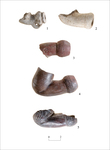
Other finds include mold-made clay tobacco pipes dated to the late Ottoman period (Fig. 16:1–5); these have a long and wide shank, a flat keel and a wide bowl with a concave base. Pipes 1 and 2 are made of white-beige clay and are typical of the eighteenth century CE. The keel of Pipe 1 has a ridge, a pierced lug handle and a rounded rim decorated with reed impressions. The keel of Pipe 2 has simple rim with rouletted decoration. Pipes 3–5 are made of well-levigated and well-fired clay and have bowl and wide rim with impressed and rouletted decoration; this type was common during the nineteenth century CE.
The Glass Finds
Yael Gorin-Rosen
About 50 identifiable and datable glass fragments were found in the excavation. These include a few vessels dated to the Late Roman, Byzantine and Umayyad periods and bracelets dated to the Mamluk and Ottoman periods. Vessels and bracelets dated to the twentieth century were found as well. Glass vessels from the same periods were also found in a previous excavation at the site (Winter 2020). A flake of raw glass was also found.
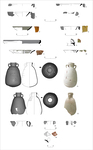
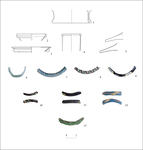
The Vessels. Vessels from the Late Roman and early Byzantine periods include a bowl with a hollow raised ring base (Fig. 17:1), a bottle or juglet with a funnel rim rounded in the fire and a pinched band below the rim (Fig. 17:2) and a bottle or juglet with a funnel rim folded inward and decorated with thick horizontal glass trail below the rim (Fig. 17:3). The bowl and Bottle/Juglet No. 2 have parallels dated to the fourth–beginning of fifth centuries CE; parallels to Bowl No. 1 were found in the previous excavation at the site (Winter 2020: Fig. 20:4) and at Khirbat el-Ni‘ana (Gorin-Rosen and Katsnelson 2007:86–88, Figs. 6:3–7, 30:1, 2), and parallels to Bottle/Juglet No. 2 were found at Khirbat el-Ni‘ana (Gorin-Rosen and Katsnelson 2007:97–98, 135, 138, Figs. 10:3, 33:13) with comparisons to graves at Ḥorbat Rimon, Mount of Olives, Samaria and Ḥammat Gader. Bottle/Juglet No. 3 is made of colorless glass with a greenish tinge, and it is characteristic of the Early and Middle Roman periods. It is similar to higher quality vessels, such as a group of vessels found at Ḥorbat Gannim, southeast of Tel Bet Shemesh (Gorin-Rosen 2022: Fig. 20). Similar bottles and juglets were found at Khirbat el-Ni‘ana, but they are made of a different fabric (Gorin-Rosen and Katsnelson 2007:98–100, 103, 135, 138, Figs. 11:6, 7, 13:1, 33:7–9 and see references therein). Bottle/Juglet No. 3 may represent an earlier period of occupation at the site; this is further supported by a small fragment coming from the center of the base of a vessel (L139; not illustrated) made of high quality glass typical of the Early or Middle Roman period.
The Byzantine period is represented by a bottle (Fig. 17:4) made of light blue glass that contains many bubbles and black impurities. It has an upright, infolded rim and a thin wall that downwards. A similar bottle was found in a previous excavation at the site in a fill above an occupation level that was dated to the Byzantine period (Winter 2020: Fig. 20:2). This type of bottle continued to be used during the late Byzantine and Umayyad periods.
Three glass objects dating to the Early Islamic period were found. A spout of an alembic (Fig. 17:5) dates to the Umayyad period. This vessel form is a small beaker with a spout below the rim. The spout is broken where it joins the body, and its narrow end is carefully cut. These vessels were used to distill and extract liquids such as medicine or essential oils. Numerous alembics of this type were found in assemblages dated to the Early Islamic period and predominantly the Umayyad period, such as those from Ramla, Bet She’an and Khirbat el-Thahiriya (Jackson-Tal 2012:68*, Fig. 3:51, 52 and see references therein). A fragment of the base of a square bottle (L114; not illustrated) was also found. Its glass is colorless with a pinkish-yellowish tinge, and it has thick walls. The base converges inwards internally to form a conical edge, while externally the wall is straight. On the bottom, there is a coarse pontil scar. These bottles are typical of the Abbasid and Fatimid periods (Gorin-Rosen 2010:231–232, Pl. 10.5:4). They have a small capacity, so they were probably used for cosmetics, essential oils or medicine. A glass weight, also from the Fatimid period (Lester, below), indicates an organized economic system at the site during this period.
The Bracelets (Fig. 17:6–13). Several bracelet fragments were found; most of them are decorated and can be typologically dated to the Mamluk and Ottoman periods. Bracelet No. 6 is small and simple; the glass is bluish-greenish and of low quality, with many bubbles and black impurities. The manufacture is low quality, and the inside bears marks from a metal tool. The bracelet has an asymmetrical semi-circular cross-section and an irregular width.
Bracelets 7 and 8 are twisted into a spiral. They have round cross-sections and are decorated with trails. Both bracelets originate from the same basket. Bracelet No. 7 was manufactured from translucent turquoise glass, and it is decorated with a thin white trail that was densely and unevenly coiled around it and raised slightly. The bracelet is covered with black and iridescent weathering that gives it an opaque look. Bracelet No. 8 has transparent glass with a light green hue, and the bracelet is decorated with a thick red trail bordered by thin opaque white trails. Multicolored twisted bracelets are known since the Umayyad period but are more characteristic of later periods and the Ottoman period, in particular (see Type C of Spaer; Spaer 1992:49–50).
Bracelets 9–11 are decorated with multi-colored patches and have a semi-circular cross-section. The glass of all three is dark and seemingly black with various colored patches. About a third of the diameter of Bracelet 9 was preserved. The bracelet is decorated with patches of green glass bordered by yellow glass with some orange; it is covered by silver weathering. The cross-section of Bracelet 10 is irregular. The bracelet is made of dark purple glass, which seems black, and it is decorated with opaque green glass patches, crossed by a trail of dark glass that is flanked by opaque yellow trails. Bracelet No. 11 is broken with only a small segment preserved. The bracelet was manufactured from dark green glass, which seems black, and it is decorated with patches that combine green and yellow glass. These bracelets belong to a group called by Spaer ‘bracelets with a semicircular cross-section and patch pattern,’ which dates to the Mamluk period and onwards, including particularly the Ottoman period (Spaer 1992:52–55, Table 3:3d(a), Fig. 13).
Bracelet No. 12 has a semi-circular cross-section with a ridge formed by the trail on its convex part. It is made from slightly translucent turquoise glass and decorated with alternating yellow and orange glass patches and, over them, a fine twisted trail formed of a dark, probably purple trail and an opaque white trail. This bracelet belongs to a group which Spaer calls ‘bracelets with a pointed cross-section and a patch pattern with a twisted white and black trail,’ which dates mostly to the Ottoman period (Spaer 1992:54–55, Tables 3:1d(1)a, 4d(1)a, Fig. 11).
Bracelet No. 13 has an elongated triangular cross-section. It is made of translucent green glass and decorated along the circumference with an opaque green band and two thin glass trails of twisted dark green and yellow glass. This bracelet belongs to a group that Spaer calls ‘bracelets with an obliquely pointed cross-section with twisted trails’ that dates to the Ottoman period (see Spaer’s Type D4; Spaer 1992:51–55, Table 3:4e(c), Fig. 15).
Raw Glass Flake. A small flake of greenish-bluish glass (L106; c. 0.3 × 2.0 × 2.0 cm) with a triangular section was discovered on the surface. This alone cannot support the presence of a glass workshop since glass flakes were also used for cutting. The use of glass as a cutting tool is supported by written sources, such as the Babylonian Talmud. It describes its use in weaving, stating “Rabbi Yehuda says ... glass of sufficient size to be used for scraping off the points of a weaver’s spindles” (Bavli, Mishnah Shabbat 8, 6). The Talmud also describes how it was used for slaughtering and butchering: “With any sharp object one may slaughter an animal, whether with a flint, or with glass shards, or with the stalk of a reed” (Bavli, Mishnah Chullin 16, 2). At the same time, workshops were discovered in many sites in the area, so there could also have been one at Khirbat et-Tineh, but more finds are necessary to confirm this supposition.
Despite its poor preservation, the glass assemblage provides information about the material culture of the settlement from different periods. The glass vessels of the Late Roman and early Byzantine periods reflect the well-known local tradition found at many sites in the region. These vessels were also found in graves and among the wasters of the workshop in Khirbat el-Ni‘ana as well as at other sites. The assemblage from the late Byzantine and Early Islamic periods supports that the settlement had an economic infrastructure or a market, in which the stamped glass weight was used. Remains from the Ottoman period include mostly bracelets that are well known from contemporaneous sites.
Glass Weight
Ayala Lester
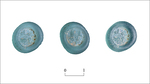
A weight formed from light grayish-greenish glass with many bubbles and covered with iridescent sandy weathering (L118, B1191; diam. 1.5–1.6 m; 1.4 gr; Fig. 18) was found on the surface. The weight’s value is half a dirham, which weighs 1.44 gr, but it is lighter because of wear and surface flaking. An inscription of two lines, one word each, was stamped on the weight:
الامام—al-amam
معد—ma‘add
The inscription names the Fatimid caliph, Ma‘add Abu Tamīm al-Mustanṣir bi-llāh III (427–487 Hijrah, 1035–1094 CE). The letters alif and lam are close together and slightly above the beginning of the word ‘amam.’ The tail of the mim at the end of amam and the dal at the end of Ma‘add curve upwards. The inscription is damaged, and the letters are not clear and sufficiently raised perhaps because the weight was used extensively and worn from use or because the glass temperature was too low when it was stamped.
Another weight bearing the name of the same caliph was found in ‘Akko (Tepper 2021). Similar weights bearing the value of dinier, diraham and their fractions are found in the British Museum (Lane-Pool 1891: Nos. 240–245, 245g, 246–250, Pl. VI), the National Collection in Damascus (Launois 1969: Nos. 117–126, Pl. III) and in two publication on glass weights from the Fatimid period (Balog 1971–1972: Nos. 24–26, Pl. IX; Balog 1973:255–256, 273–274, Pl. XI: Nos. 255.1, 255.2).
Metal Ring
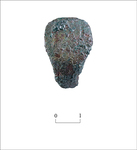
A simple bronze ring (L109, B1061; Fig. 19) was found on the surface next to the Mamluk-period kiln. Its lower part was broken. Shallow incisions on the ring head may be remnants of geometric decoration or an illegible inscription. Similar rings from the Mamluk period with geometric patterns or Arabic inscriptions were discovered at Gane Ṭal (Amitai-Preiss 2021:289, Fig. 1).
Summary
The finds from the current excavation join those from Haddad’s excavation and shed light on the periods in which the site was occupied. The coin and two Late Roman glass vessels may date the establishment of the settlement. Clear evidence for occupation at the site during the Byzantine period (fifth–sixth centuries CE) consists of the winepress, numerous pottery vessels, including Gaza Ware wine jars, and glass vessels. The winepress may indicate that the southern part of the site was used for wine production during this time. The architectural remains and fragments of pottery and glass vessels, including an alembic fragment that may have been used for medicine, indicate that the site was also occupied during the Early Islamic period (eighth–tenth and perhaps even the eleventh centuries CE) and that during this time, the southern part of the site was used for residential purposes. The pottery assemblage and glass weight from the Fatimid period (tenth–eleventh centuries CE) reflect settlement continuity. After a period of abandonment, occupation was renewed during the Mamluk period. The wide variety of finds, including wheel-made pottery, some of them imported, handmade pottery, coins and glass bracelets, support the presence of the flourishing settlement during the thirteenth–fourteenth centuries CE. A small kiln, perhaps for producing pottery, was active at the site during this period. The cist graves covered with jars in the cemetery south of the site may indicate that a new population from eastern Asia settled at the site. The site was again abandoned for a few centuries, and this was followed by a renewed occupation at the end of the eighteenth century CE, which lasted until the first half of the twentieth century CE. The meager finds from this period indicate that it was a temporary settlement, using perhaps mud huts with courtyards containing ṭabuns dug into the ground and installations.
References
Amitai-Preiss N. 2021. Four Inscribed Bronze Rings from Gane Ṭal. ‘Atiqot 102:289–292. https://doi.org/10.70967/2948-040X.1956
Balog P. 1971–1972. The Fātimid Glass Jeton. Annali dell’Istituto italiano di numismatica 18–19:175–264.
Balog P. 1973. The Fātimid Glass Jeton. Annali dell’Istituto italiano di numismatica 20:121–212.
Gorin-Rosen Y. 2010. The Islamic Glass Vessels. In O. Gutfeld. Ramla: Final Report on the Excavations North of the White Mosque (Qedem 51). Jerusalem. Pp. 213– 264.
Gorin-Rosen Y. 2022. The Glass Finds. In E. Kogan-Zehavi, H̱orbat Gannim. HA–ESI 134. https://doi.org/10.69704/jhaesi.116.2004.26211
Gorin-Rosen Y. and Katsnelson N. 2007. Local Glass Production in the Late Roman–Early Byzantine Periods in Light of the Glass Finds from Khirbat el-Ni‘ana. ‘Atiqot 57:73–154. https://doi.org/10.70967/2948-040X.1761
Gorzalczany A. 2009. A New Type of Cemetery from the Late Mamluk and Early Ottoman Periods from Central Israel. Levant 41/2:223–237. https://doi.org/10.1179/007589109X12484491671211
Haddad E. 2020. Khirbat et-Tineh (Kefar Menaẖem). HA–ESI 132. https://doi.org/10.69704/jhaesi.116.2004.25694
Jackson-Tal R.E. 2012. The Early Islamic Glass Finds from Khirbat el-Thahiriya. ‘Atiqot 71:57*–72*. https://doi.org/10.70967/2948-040X.1563
Lane-Poole S. 1891. Catalogue of Arabic Glass Weights in the British Museum. London.
Launois A. 1969. Estampilles, Poids, Étalons Monétaires et Autres Disques Musulmans en Verre. Bulletin de Études Orientales 22:70–121.
Majcherek G. 1995. Gazan Amphorae: Typology Reconsidered. In H. Meyza and J. Młynarczyk eds. Hellenistic and Roman Pottery in the Eastern Mediterranean—Advances in Scientific Studies (Acts of the II Nieborów Pottery Workshop, Nieborów, 18–20 December 1993). Warsaw. Pp. 163–178.
Spaer M. 1992. The Islamic Glass Bracelets of Palestine: Preliminary Findings. JGS 34:44–62.
Tepper Y. 2021. Akko, Ha-‘Amal Street. HA–ESI 133. https://doi.org/10.69704/jhaesi.116.2004.26039
Winter T. 2020. Glass Finds. In E. Haddad, Khirbat et-Tineh (Kefar Menaẖem). HA–ESI 132. https://doi.org/10.69704/jhaesi.116.2004.25694
Keywords
Kafr Menachem, Byzantine period, Early Islamic period, Mamluk period, Ottoman period, winepress, kiln, cemetery, cist graves, glass weight
Publication Date
26/10/2026
Link to Excavation Repository
Report Type
Final Report