
Ḥorbat Ẓerifin (A-8684)
Permit/License Number
A-8684
Excavation Report
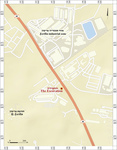
During May 2020, a trial excavation was conducted on the eastern fringe of Ḥorbat Ẓerifin, west of Road 44 (Permit No. A-8684; map ref. 186108–24/651831–44; Fig. 1), prior to laying a sewage pipe. The excavation, on behalf of the Israel Antiquities Authority and funded by the Be’er Ya‘aqov municipality, was directed by I. Jonish (field photography, surveying and drafting), with the assistance of R. Toueg (preliminary inspections), Y. Amrani and Z. Lotan (administration), H. Torgë (pottery), Y. Gorin-Rosen (glass), M. Intrator (fauna), L. Sandberg (numismatics), D. Gazit (studio photography), Y. Tepper (scientific guidance) and I. Korenfeld and A. ‘Azab from the IAA.
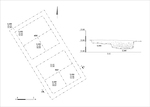
Remains of a settlement dated from the Byzantine period until modern times were discovered nearby in the past (Kohn-Tavor 2008; Toueg 2011). In the current excavation, two excavation squares were opened (4DE and 5EF; Fig. 2), and habitation levels from the Early Islamic period, which contained pottery and glass fragments, coins and animal bones, were found.
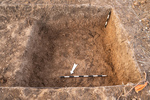
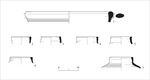
The predominant finds in Square 4DE were unidentifiable body fragments of pottery and animal bones (L101, L103). In L101, a Byzantine-period coin was also found. The coin, a pentanummium, is a local imitation of an imperial type, which was probably minted in Ashqelon in the sixth century CE (IAA 180804). The edge of a refuse pit which was exposed in the southwestern part of Square 5EF (L105; Fig. 3) contained numerous pottery fragments (L105, B1019) from the Islamic period (eighth–eleventh centuries CE), among them a krater dated to the eighth–eleventh centuries CE (Fig. 4:1) and bag-shaped jars dated to the sixth–eighth centuries CE (Fig. 4:2–7). A large quantity of unidentifiable pottery body-fragments was found in the pit.
On the surface surrounding the excavation squares and on top of the balks, some glass items dated to the Late Roman–Early Islamic periods were found as well as a worn Mamluk coin (L100; IAA 180803) dated to the fourteenth–fifteenth centuries CE (c. 1350–1450 CE).
The Glass Finds
Yael Gorin-Rosen
Four glass items were found in the excavation, including three vessel fragments and a glass chunk. Two fragments of bases dated to the Late Roman and Byzantine periods (not illustrated) were found in Refuse Pit 105. One is the center of the base of a bowl with a coarse pontil scar, and the other is a flat base of a bottle that is slightly concave at its center.
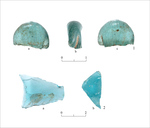
On the surface (L100) was a small fragment of a double pinched handle (Fig. 5:1), known as ‘thumb rest.’ The handle is made of bluish-greenish glass that was pulled like a thick trail, folded, pinched and flattened into a disc (Fig. 5:1b). The production method and the tool marks are evident in the subtle differences between the two faces of the handle (Fig. 5:1a, 1c). Handles of this type first appeared during the Late Roman period, and they were very common during the Early Islamic period. The quality and hue of the glass here is more similar to the later pinched handles, corresponding with the Early Islamic date of the site. Handles pinched on their upper part and sometimes on the lower part were found in Ramla. In particular, three were found there in Area A of the excavation at the Azrieli shopping mall (Winter 2022:396–397, Fig. 7:2–4 and see references therein to other excavations in Ramla and Bet She’an). Handle No. 2 from the Ramla excavation has two pinches, one on its upper part and one on its lower part. The fragment that was found in the current excavation is similar to the example from Ramla, suggesting that they were the same type. Judging by the hue and quality of the glass of the three handles in Ramla, they probably date to the Umayyad or early Abbasid period (second half of the seventh century and the eighth century CE).
The chunk of glass (Fig. 5:2) was discovered in Refuse Pit 105. This is an elongated chunk of raw glass, with a triangular cross-section (Fig. 5:2b). Both its edges are broken, and its sides are retouched. The shape is similar to a flint or obsidian blade (Fig. 5:2a). While it may be a flake from a larger glass chunk that was intended to be melted in the glass-kiln, the retouch along the sharp edges between the sides of the triangle may indicate that it was used as a cutting tool. Written sources support that glass was used as a cutting tool. For example, the Babylonian Talmud shows it was used in weaving, writing “Rabbi Yehuda says ... glass of sufficient size to be used for scraping off the points of a weaver’s spindles” (Bavli, Mishnah Shabbat 8, 6; Grossmark 1989:155). In addition, textual evidence supports it was used for slaughtering and butchering: “with any sharp object one may slaughter an animal, whether with a flint, or with glass shards, or with the stalk of a reed” (Bavli, Mishnah Chullin 16, 2).
Considering the written sources, glass chunks were presumably used as cutting tools regularly, but so far only a few examples of retouched glass chunks were published in contexts that may testify to their use in household chores rather than for melting in a glass workshop. An elongated glass chunk that was deliberately fashioned into a blade-like tool was found in the excavation on Ha-Degel Street in the Old City of Jerusalem (Katsnelson 2021: Fig. 14:2 and see references therein to a similar tool from Jerash dated to the sixth century CE).
According to the hue and quality of the glass from the current excavation at Ḥorbat Ẓerifin, the glass chunk is dated to the late Byzantine or Umayyad period and not earlier.
Although the assemblage in this excavation is meager, the glass chunk may indicate glass manufacture at the site or its vicinity or use of a glass as a tool.
The Faunal Assemblage
Midori Intrator
A small assemblage of animal bones was discovered in the excavation (Table 1). The identification of the bones was done utilizing the comparative collection from the Laboratory of Archaeozoology at the University of Haifa. Identifiable bones were recorded following the methods outlined by Lyman (2008).
The faunal assemblage contained mostly fragments with a few identifiable elements. Fauna originating from L101 and L103 come from contexts dating to the Early and Late Islamic periods, and L105 has fauna coming from an Early Islamic garbage pit. A total of ten bones and teeth were cataloged, with the species, skeletal element, age and taphonomic data recorded (Table 1). The assemblage is composed of the remains of Equus sp. (likely donkey, N=5), Bos (cattle, N=2), Capra/Ovis (goat/sheep, N=2) and Camelus sp. (camel, N=1). All teeth found were adult teeth displaying some wear, and bones with the epiphysis present showed fusion, typical for mature individuals.
Surface examination of the bones revealed that they were not exposed to fire or weather damage, and the only taphonomic alteration is carnivore gnawing marks on the distal end of one cattle metacarpal. There is no evidence for human activities in the form of butchery marks.
In conclusion, the faunal assemblage very small and does not allow conclusions to be drawn about the site's economy.
The Early Islamic activity area that was uncovered in the excavation is contiguous with remains of a settlement from this period that was previously found at the site (Kohn-Tavor 2008). The site was near the main road that connected the port city of Jaffa to Jerusalem, and therefore presumably served also as a waystation for travelers on the road. The proximity to the city of Ramla indicates that the site was probably part of the agricultural and industrial hinterland of the city.
References
Grossmark T. 1989. Jewish Glass-Making in the Land of Israel in the Roman and Byzantine Periods. M.A. thesis. University of Haifa. Haifa.
Katsnelson N. 2021. The glass finds. In E.D. Kagan. Jerusalem, the Old City, Ha-Degel Street. HA–ESI 133. https://doi.org/10.69704/jhaesi.116.2004.25979
Kohn-Tavor A. 2008. H̱orbat Ẕerifin. HA–ESI 120. https://doi.org/10.69704/jhaesi.116.2004.814
Lyman R.L. 2008. Quantitative Paleozoology. Cambridge. https://doi.org/10.1017/CBO9780511813863
Toueg R. 2011. H̱orbat Ẕerifin (East). HA–ESI 123. https://doi.org/10.69704/jhaesi.116.2004.1702
Winter T. 2022. Early Islamic-Period Glass Finds from Ramla. ‘Atiqot 108:383–412. https://doi.org/10.70967/2948-040X.1156
Keywords
habitation levels, activity area, Early Islamic period, pottery sherds, glassware, coins, animal bones, agricultural hinterland
Publication Date
28/10/2026
Link to Excavation Repository
Report Type
Final Report