
Ravid (Southwest) (A-9452)
Permit/License Number
A-9452
Excavation Report
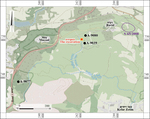
In December 2022, a trial excavation was conducted southwest of Kibbutz Ravid (Permit No. A-9452; map. ref. 242110–84/749912–76; Fig. 1), prior to construction. The excavation, undertaken on behalf of the Israel Antiquities Authority and financed by the Israel Electric Company, was directed by P.R. Zajac, with the assistance of Y. Ya‘aqobi (administration), R. Be’eri (scientific guidance), Y. Shmidov (photogrammetry and drone photography), A. Kleiner (GPS), E. Dalali-Amos (plans), A. Shapiro (location map), H. Mamalya (preliminary survey), Y. Tzur, the sub-district archaeologist, and laborers from Kafr Manda.
The excavation was conducted on a southern slope of a low hill (c. 140 m asl) in the northern part of the Lower Galilee. A previous survey east of Kibbutz Ravid documented several ancient remains, including buildings, caves, tombs, cisterns and an olive press (Cinamon 2012 [Fig. 1: S-65/2008]). Prior excavations conducted in the vicinity of the current excavation area exposed field towers and a rock-hewn winepress (R. Namouz, pers. comm. [Permit Nos. A-9039, A-9077, A-9080]). Moreover, rock-hewn winepresses and stone heaps were also observed to the east (H. Mamalya pers. comm.) and west of the excavation area (pers. observation and I. Tor, pers. comm.).
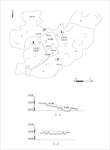
During the preliminary survey of the area, four findspots—heavily overgrown with vegetation—were identified. The excavation (Fig. 2) was conducted at these findspots, and it exposed two rock-cut winepresses (1 and 2) that share a similar plan and two circular field towers (1 and 2) of unknown dates. The excavation reached bedrock.
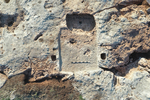
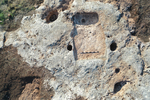
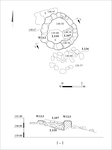
Hewn winepresses. Winepress 1 (Figs. 3, 4) comprised a shallow rectangular treading floor (L120; 1.7 × 2.0 m; depth 0.3 m) with rounded corners flanked by two rectangular rock-cut depressions (diam. 0.3 m, depth 0.25 m), an elliptical collecting vat (L123; 0.81 × 1.10 m; depth 0.44 m) and a circular settling pit at its bottom.
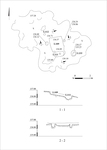
Winepress 2 (Figs. 5, 6) also has a shallow treading floor with rounded corners (L109; 1.7 × 2.0 m; depth 0.3 m) flanked by two circular depressions (diam. 0.3–0.5 m, depth 0.4 m), an elliptical collecting vat (L111; 0.54 × 1.17 m; depth 0.39 m) and a circular settling pit (diam. 0.25 m, depth 0.1 m) at its bottom. A small section of a hewn wall was preserved between the treading floor and the collecting vat on its western side; it appears to have been part of a narrow partition wall that separated them. Approximately 0.5 m northwest of the treading floor of Winepress 2, a rock-hewn cupmark was exposed (L112; diam. 0.3 m, depth 0.2 m), and c. 0.7 m east of the collection vat is a conical pit (L133; upper diam. 0.84 m, lower diam. 0.4 m, depth 0.6 m). The function of both features remains unknown.
The layout of the winepresses, including the partition wall in Wine Press 2, is similar to winepresses dated to the Early and Middle Bronze Ages (Covello-Paran, Getzov and Tepper 2020). The excavation of the winepresses did not yield any pottery that could be used to date their quarrying.
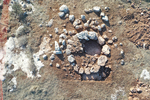
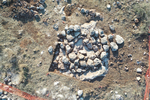
Field towers. Field Tower 1 (Figs. 7, 8) comprised a single circular wall (W113; external diam. c. 3.7 m, internal diam. c. 2.6 m, thickness c. 0.8 m), built of large (max. dimensions 0.30 × 0.76 × 1.00 m) and medium-sized (c. 0.12 × 0.32 × 0.37 m) fieldstones, of which some were roughly hewn. The wall was founded on bedrock and preserved to a maximum height of two courses (0.76 m). The bedrock also served as the floor (L110) of the tower. Stone rubble (L107) inside and along the northern face of the tower attested to collapse of its upper courses. About 0.8 m southeast of the tower, a semi-circular stone (L136; 0.11 × 0.30 × 0.40 m) with a round perforation (diam. 0.12 m, depth 8 cm) was identified on the site surface.
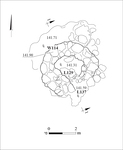
Field Tower 2 (Figs. 9, 10) consisted of a circular wall (W114; external diam. c. 3.9 m, internal diam. c. 1.7 m, thickness 0.96–1.21 m) comprised of two rows of partly hewn fieldstones, founded on bedrock and preserved to a height of one course (0.6 m). The outer row was built of large (max. dimensions 0.25 × 0.60 × 0.80 m) and medium-sized (c. 0.2 × 0.3 × 0.4 m) fieldstones, whereas the inner row was constructed of only medium-sized fieldstones (c. 0.2 × 0.3 × 0.5 m). A collapse of medium-sized stones and rubble (L129) covered the center of the tower. The opening (width 1 m) was in the southeastern part (L137).
No finds were recovered that could be used to date the construction of the field towers.
Summary. The excavation uncovered two rock-hewn winepresses and two field towers with no datable finds. The layout of the winepresses resembles Early and Middle Bronze Age so-called Ta‘anakh winepresses (for the type, see Covello-Paran, Getzov and Tepper 2020). Field towers similar to those discovered in the excavation were documented and excavated throughout Israel and dated to the Iron Age–Byzantine period. These towers were used as storage facilities for agricultural produce and as watchmen huts (Ron 1977; Dar 2018).
In conclusion, the excavation enhances our knowledge of the distribution of possible Early and Middle Bronze Age winepresses and their occurrence in the northern part of the Lower Galilee. The excavated winepresses and field towers, as well as the numerous observed winepress installations in the vicinity of the excavation, point to the presence of a nearby yet to be discovered settlement, whose residents were engaged in wine production.
References
Dar S. 2018. Field Towers and Their Affinity to Ancient Agriculture. Eretz-Israel 53:111–128 (Hebrew; English summary, p. 188*).
Cinamon G. 2012. Horbat Sabban, Survey. HA-ESI 124. https://doi.org/10.69704/jhaesi.116.2004.2040
Covello-Paran C., Getzov N. and Tepper Y. 2020. The “Ta‘anakh Winepress” Revisited: Further Evidence of the Middle Bronze Age Wine Industry in the Jezreel Valley. In J. Ebeling and P. Guillaume eds. The Woman in the Pith Helmet: A Tribute to Archaeologist Norma Franklin. Atlanta. Pp. 123–147. https://doi.org/10.5913/2020334.ch08
Ron Z.Y.D. 1977. Stone Huts as an Expression of Terrace Agriculture in the Judean and Samarian Hills. Ph.D. diss. Tel Aviv University (Hebrew; English summary, pp I–XIX).
Keywords
Hewn winepresses, Ta‘anakh winepress, Early Bronze Age, Middle Bronze Age, round field towers, lower Galilee
Publication Date
02/10/2026
Link to Excavation Repository
Report Type
Final Report