
‘Atlit, Crusader Cemetery – 2019 and 2021 (G-54/2019, G-60/2021)
Permit/License Number
G-54/2019, G-60/2021
Excavation Report
In May and June 2019 and November 2021, the fifth and sixth excavation seasons at the ‘Atlit Crusader cemetery were conducted (License Nos. G-54/2019, G-60/2021; map. ref. 194692–738/734709–813). The project was supported and funded by the French Ministry for Europe and Foreign Affairs (MEAE), the French Research Center in Jerusalem (CRFJ), the Archaeology Division of the Israel Antiquities Authority (IAA), the Ḥof Ha-Carmel Regional Council, the University of Bordeaux and the French National Institute for Preventive Archaeological Research (INRAP). The excavation was directed by Y. Gleize (INRAP, University of Bordeaux; photography of Figs. 7, 9), with the assistance of J.-C. Barron, C. Berton, S. Dorso, P. Duratti, P. Lecaulle, Y. Li, M. Myers, H. Sha, A. Rizzo, V. Shotten-Hallel and P. Tigreat (2019 excavation season), C. Bouffiès (2019 and 2021 excavation seasons; drawing of Figs. 5, 8), M. Greuin, R. Kool, C. Lacourarie and Y. Vitkalov (2019 and 2021 excavation seasons; excavation and recording), E. Mercier (2019 and 2021 excavation seasons; pottery drawing of Fig. 6) and V. Pirsky and S. Alon (2019 and 2021 excavation seasons; plans and drafting).
The previous excavation seasons (2015–2018) at the ‘Atlit Crusader cemetery, northeast of Pilgrims’ Castle (Château Pèlerin), provided new data on the typology of the graves and the use of the cemetery (Gleize and Dorso 2019; Gleize 2021a; 2021b; Gleize and Lacourarie 2024).
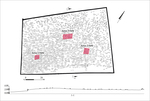
The recent field season continued excavations in Area 1 (Figs. 1, 2) and completed the four-year research project (2018–2021): Le cimetière médiéval d’Atlit: Utilisation et évolution d’un espace funéraire du royaume latin de Jérusalem (XIIIe s.). At the end of the excavations, pits were refilled, and stone grave markers were restored to their original positions. In 2020, the field season was suspended due to the COVID-19 pandemic; consequently, the research team focused on post-excavation studies (CAD spatial mapping of the graves, the compilation of a comprehensive catalog of the burials, DNA analysis, radiocarbon dating, etc.).
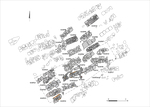
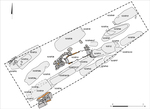
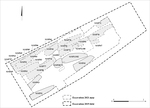
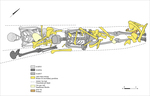
In 2019 and 2021, the excavation was conducted in Area 1 (25 sq m; Fig. 2), and 33 graves were exposed (S1SP11/80, S1SP13/82, S1SP15, S1SP16, S1SP18/29, S1SP19, S1SP20a, S1SP20b, S1SP21, S1SP24, S1SP25/37, S1SP28/73, S1SP31, S1SP32/33, S1SP34, S1SP35, S1SP36, S1SP38, S1SP40, S1SP41, S1SP44, S1SP45, S1SP46, S1SP47, S1SP50, S1SP51, S1SP52, S1SP53, S1SP55, S1SP60/67, S1SP70, S1SP72, S1SP78), and the ossuary pit (S1F12) and 19 others were partially excavated (S1SP17, S1SP22, S1SP23, S1SP39, S1SP42, S1SP26/43, S1SP48, S1SP49, S1SP57, S1SP61, S1SP63, S1SP64, S1SP65, S1SP69, S1SP70, S1SP71, S1SP75, S1SP81, S1SP87) (Figs. 3, 4). In 2021, excavations reached bedrock, making it possible to study burials from all chronological phases of the cemetery’s use.
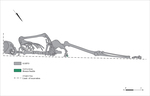
The graves in Area 1 were marked with kurkar blocks, most of which were originally plastered (Fig. 2). There were at least 4 burials per sq m. Contrary to observations from previous campaigns in this area (Gleize and Dorso 2019; Gleize and Lacourarie 2024), numerous graves cut and overlap each other (Fig. 5). Many bones in secondary position were also found in burials, and one specific pit contained only bones in secondary position (S1F12). Combined with the high burial density, this suggests that some graves were disturbed to make room for new burials, indicating that Area 1 was intensively used as a cemetery.
Archaeothanatological analysis of these new burials confirms previous observations. Graves generally belong to a single individual, and only one grave (S1SP71) contained two individuals – an adult male and a young child. Most of the deceased were buried in a pit that was originally closed with a wooden cover. Only one grave contained a wooden coffin (S1SP75), attested by the presence and location of several iron nails. This is the second wooden coffin identified in the cemetery; the other was found in Area 2 during the 2015 excavation season (Gleize and Dorso 2019; Gleize 2021a).
In Area 1, the biological analysis of the bones shows variety in the individuals buried, including both adults and immature individuals and males and females. However, the proportion of adult males appears to be higher in the deeper burial layers. Thus, how the cemetery was used changed overtime.
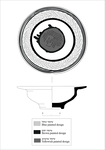
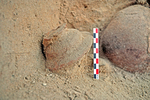
Cypriot, Italian and local pottery was unearthed. Several types of wares, namely table and cooking pots, were identified, including Proto Maiolica glazed ware (Fig. 6), and these vessels could have been used for funerary meals. Some bowls may have originally been placed on the lids covering the pits, which eventually collapsed into the graves (Fig. 7).
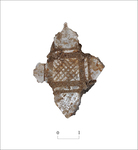
Some elements of adornment and clothing were also found. One buckle (Fig. 8), one bead and several buttons were discovered in situ on skeletons. Two mother-of-pearl crosses (Fig. 9), one of which was worn, are pilgrimage objects that bear similarities to finds from the excavation of the medieval town of ‘Atlit (Johns 1997; Dorso, Gleize and Mercier 2023). These elements show that some of the deceased were dressed.
The discovery of objects (pottery, pendants, etc.) and the biological data of some deceased individuals parallel observations from Area 2 (Gleize and Dorso 2019) and supports that the cemetery was divided into distinct areas.
The 2019 and 2021 excavation campaigns provide new data on the cemetery. The excavations show the diversity of funerary practices and the high density of burials during the cemetery’s relatively short period of use. The archaeological research carried out on the cemetery of ‘Atlit highlights the need for an interdisciplinary study using archaeothanatology (Knüsel and Schotsmans 2022) to understand the cultural practices of the Crusader-period communities in the Holy Land. The results allow us to compare the use and the population of two sectors (Areas 1 and 2) of the cemetery. Additional analyses are underway and will be published soon (Gleize et al. 2026).
The excavations did not target the peripheral areas of the cemetery; this is problematic because these areas are threatened by coastal erosion. The aim of future excavations will be to understand the links between the funerary space, the enclosure of the cemetery and the bordering medieval road by excavating the peripheral areas. This new data will allow us to see if there are differences in funerary practices between the center and the periphery of the cemetery.
References
Dorso S., Gleize Y. and Mercier E. 2023. On the Meaningfulness of Small Finds: Two New Mother of Pearl Cross Pendants from ‘Atlit and their Wider Context. In R.G. Khamisy, R.Y. Lewis and V.R. Shotten-Hallel eds. Exploring Outremer II: Studies in Crusader Archaeology in Honour of Adrian J. Boas (Crusades-Subsidia). London–New York. Pp. 235–254. https://doi.org/10.4324/9781003146926-12
Gleize Y. 2021a. Archaeothanatology, Burials and Cemeteries: Perspectives for Crusader Archaeology. In V. Shotten-Hallel and R. Weetch eds. Crusading and Archaeology: Some Archaeological Approaches to the Crusades (Crusades – Subsidia 14). London. Pp. 284–299. https://doi.org/10.4324/9781315142883-13
Gleize Y. 2021b. The Medieval Cemetery of ‘Atlit: Historiography and New Archaeological Data (2014–2019). In G. Fishhof, J. Bronstein and V.R. Shotten-Hallel eds. Settlement and Crusade in the Thirteenth Century: Multidisciplinary Studies of the Latin East (Crusades – Subsidia 15). London–New York. Pp. 124–138. https://doi.org/10.4324/9780429203886-10
Gleize Y. and Dorso S. 2019. ‘Atlit, Crusader Cemetery. HA-ESI 131.
https://doi.org/10.69704/jhaesi.116.2004.25609
Gleize Y. and Lacourarie C. 2024. ‘Atlit, Crusader Cemetery – 2018. HA-ESI 136.
https://doi.org/10.69704/jhaesi.116.2004.26447
Gleize Y., Mercier É., Lacourarie C., Goude G., Milanese Branca N., Deguilloux M.F., Mendisco F. and Pemonge M.H. 2026. Atlit (Latin Kingdom of Jerusalem, 13th century): Crusader Cemetery or a Funerary Space at the Crossroads of Different Cultures? Insights from Some Data and Research Perspectives. Bulletins et mémoires de la Société d’Anthropologie de Paris 38/2. https://doi.org/10.4000/16pu8
Johns C.N. 1997. Guide to ‘Atlit: The Crusader Castle, Town and Surroundings. In D. Pringle ed. Pilgrims’ Castle (‘Atlit), David’s Tower (Jerusalem) and Qal‘at ar-Rabad (‘Ajlun): Three Middle Eastern Castles from the Time of the Crusader (Variorum Collected Studies Series 579). Aldershot. Pp. 1–98.
Knüsel C.J. and Schotsmans E.M.J. 2022. The Routledge Handbook of Archaeothanatology: Bioarchaeology of Mortuary Behaviour. London. https://doi.org/10.4324/9781351030625
Keywords
cemetery, graves, Crusader period, Crusaders, ‘Atlit Fortress, wooden coffin, pilgrims
Publication Date
12/10/2026
Report Type
Preliminary Report